
By Nève Djevalikian-Couture, MSc student at Concordia University
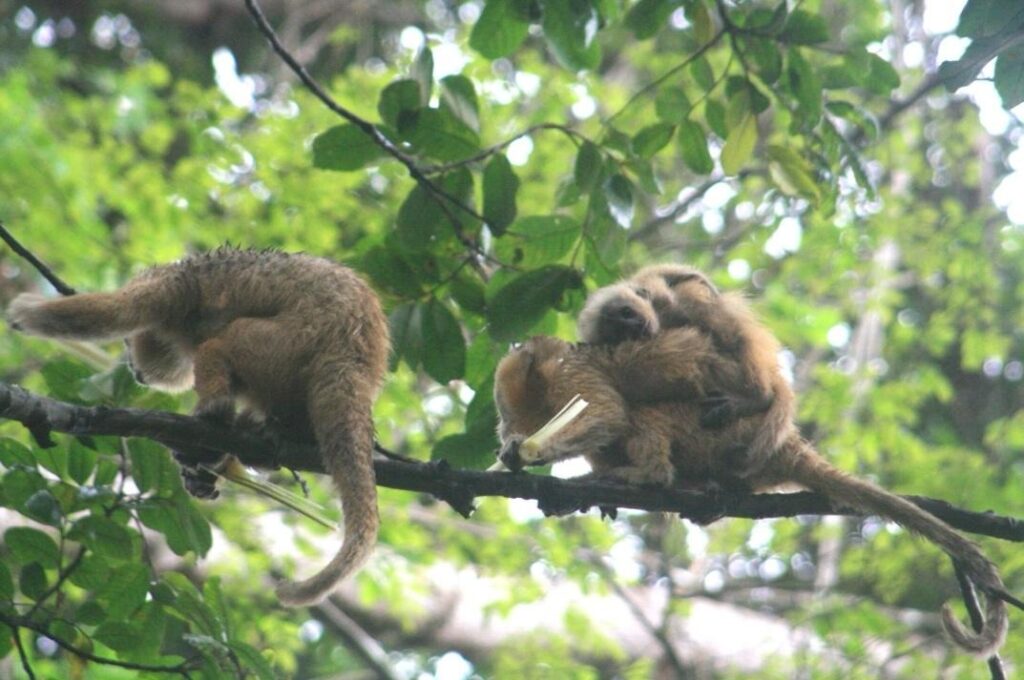
Content warning: This article contains an image of a dead infant capuchin monkey.
From capuchin monkeys to salmon
Last summer while conducting my MSc fieldwork in the Brazilian Atlantic Forest (training for which was partly supported by a QCBS Excellence Award. Thank you QCBS!), I observed a group of wild blond capuchin monkeys (Sapajus flavius) and noticed something that took my breath away: an exceptionally small newborn clinging to its mother’s back. Surely no more than a few days old, it was the smallest I had ever seen in the wild. The next day, we found the same group, but something different immediately caught my attention. The mother was now holding that same infant under her arm (instead of carrying it on her back). Through my binoculars, I confirmed my sad suspicions: the baby had died. We watched her continue foraging and keeping up with the group while still carrying, grooming and licking her lifeless infant. I was emotionally shaken.

A few months later, while travelling to Victoria, BC, to present my research at a conference, we made a stop at Goldstream Provincial Park. There, I witnessed a very different reproductive scene. Hundreds of salmon, mostly chum (Oncorhynchus keta), some coho (O. kisutch) and chinook (O. tshawytscha) swam frantically upstream to spawn. After depositing thousands of eggs in the gravel, these exhausted fish would die, never to see their offspring. Big birds, bald eagles (Haliaeetus leucocephalus), sea gulls (Larus pacificus), ravens (Corvus corax) and crows (Corvus brachyrhynchos), were already at the scene, opportunistically feeding on eggs and carcasses. Interestingly, this spectacle brought back the image of the capuchin mother clinging to her infant, still caring for it hours after its death, and somehow, I was still just as emotionally shaken.

This contrast illustrates two fundamentally different reproductive strategies and raises important questions: Why do some animals have only one offspring every few years (like elephants), while others produce large numbers of young all at once (like salmon) or have frequent larger litters (like rats and mice)? What drives variation in parental investment across species? The answer, I learned in one of my favourite ecology classes a few years ago at UQAM.
Different evolutionary strategies
In 1967, ecologists Robert MacArthur and E.O. Wilson proposed a framework to understand why species reproduce so differently. Their theory is based on a simple idea: organisms have limited energy, and they must divide it between survival and reproduction. Some species, like rabbits, known as r-selected (r standing for the intrinsic rate of population increase), invest in producing many offspring, but spend little time or energy on each one. Species that are r-selected are associated with characteristics such as small body size and shorter lifespan. Others, like humans, called K-selected species (K standing for the carrying capacity of the environment), produce fewer offspring but invest much more in their care and survival. They usually are bigger and live longer. These differences are part of a species’ life history traits (things like how long they live, when they start reproducing, and how many offspring they have) that have evolved to help them cope with the conditions of their environment.
The salmon example

When in Victoria, I got to observe just how much energy salmon put into reproducing. They migrate back to their freshwater birth location by swimming hundreds of kilometers upstream, and their bodies change as hormones get them ready to spawn. At the spawning site, females dig in the gravel and each one releases a couple thousand eggs that are fertilized by the males. After that, they provide no parental care at all. After spawning, most of them will die from exhaustion and decompose. Their body will break down and add nutrients to the ecosystem, which might help a few offspring survive. Out of all those thousands of eggs, very few get to hatch and even fewer make it to adulthood.
This kind of strategy works well in unpredictable environments, where survival is mostly a matter of luck. By producing so many eggs, salmon make it more likely that at least some will survive, no matter what challenges they face.


The capuchin example
The capuchins I observed in Brazil show the opposite reproductive strategy. Females usually give birth to only one infant about every two years, but the amount of care invested in that single offspring is very high.
A mother spends an incredible amount of energy gestating, giving birth, feeding, transporting and teaching her offspring. For the first few months, the infant clings almost constantly to its mother as she moves and forages through the canopy. I watched mothers spend long periods grooming their young and teaching them important skills. Weaning takes many months, and even after that, young capuchins stay close to their mothers, continuing to learn social behaviors and group dynamics. In some species, males contribute substantially and directly to parental care as well. Even in capuchin monkeys, where males are much less involved than females, males do participate in parental care, sometimes helping with infant transportation.
This K-selected strategy has clear benefits when looking at survival rates. For primates, although mortality is highest during the first months of life, individuals that survive this vulnerable period tend to have very high survival, with rates approaching 100% between ages 2 and 6 in capuchins. Each offspring represents a major investment, and mothers focus on maximizing their chances of surviving long enough to reproduce.
While we still don’t know if capuchins can truly understand death, it is reasonable to suggest that behavioral responses such as mothers continuing to carry and groom their dead infant reflects the depth of such an intensive parental investment.
It is also interesting to note that, while a distinct concept from parental investment, many K-selected social species also exhibit cooperative behaviors such as caring for injured or disabled group members. This represents another type of investment that may contribute to the group cohesion, survival of kin, and individual survival, something that’s less common in r-selected species who focus more on rapid growth rather than on developing a stable social group.
A continuum of strategies
To come back to reproductive strategies, r- and K-selection aren’t rigid categories. They are more like two ends of a spectrum. Most species fall somewhere in between, and their reproductive strategies have evolved to fit the conditions they live in. Where a species lands on this spectrum depends on things like how stable its environment is, how likely its young are to survive, how long it lives, and how much competition it faces for resources. Generally, species in stable environments lean toward K-strategies, while those in unpredictable or changing environments lean toward r-strategies. Even though r- and K-selection are still useful ways to think about reproduction, scientists today also talk about “fast” and “slow” life history strategies instead. It’s basically the same idea, but these terms better capture how we now understand animals to be spreading their energy and effort across their lives.


Conclusion
Observing parental care in capuchins and watching salmon spawn showed me two very different ways of solving the same overall evolutionary problem: passing genes on to the next generation. The long-lasting bond between a capuchin and its infant and the salmon’s exhausting upstream journey, which ends in death are both reflections of effective strategies shaped by very different ecological pressures.
Neither is “better” than the other. A capuchin that puts most of its energy into raising just one baby and a salmon that lays thousands of eggs are both successful in their own ways, shaped by the environments that they evolved in. This shows just how diverse reproductive strategies can be, and how evolution shapes behaviour, including parental care, to help animals handle the challenges of their specific habitats.

About the author:
Nève Djevalikian-Couture is an MSc student in the Primatology and Interdisciplinary Environmental Studies (PIES) Lab at Concordia University and is a student member of QCBS. She is grateful for the support provided by QCBS and by Dr. Renata Ferreira, who hosted her fieldwork through the Federal University of Rio Grande do Norte in Brazil. She is fascinated by the natural world and all the wonderful creatures that share it with us.
Instagram: @neve_dc, @pies_lab_concordia
Linkedin: linkedin.com/in/neve-djevalikian-couture
References:
Cefas. (n.d.). *Salmon life cycle*. Centre for Environment, Fisheries and Aquaculture Science. [https://www.cefas.co.uk/iys/salmon-life-cycle/](https://www.cefas.co.uk/iys/salmon-life-cycle/)
Janson, C., Baldovino, M. C., & Di Bitetti, M. (2012). The group life cycle and demography of brown capuchin monkeys (*Cebus [apella] nigritus*) in Iguazú National Park, Argentina. In P. M. Kappeler & D. P. Watts (Eds.), *Long-term field studies of primates* (pp. 185–212). Springer. [https://doi.org/10.1007/978-3-642-22514-7_9](https://doi.org/10.1007/978-3-642-22514-7_9)
MacArthur, R. H., & Wilson, E. O. (1967). *The theory of island biogeography*. Princeton University Press.
Medeiros, K., Bastos, M., Jones, G., & Bezerra, B. (2019). Behavior, diet, and habitat use by blonde capuchin monkeys (*Sapajus flavius*) in a coastal area prone to flooding: Direct observations and camera trapping. *International Journal of Primatology, 40*(4–5), 511–531. [https://doi.org/10.1007/s10764-019-00103-z](https://doi.org/10.1007/s10764-019-00103-z)
NOAA Fisheries. (2020). *Pacific salmon survival pyramid*. National Oceanic and Atmospheric Administration. [https://www.fisheries.noaa.gov/resource/educational-materials/pacific-salmon-survival-pyramid](https://www.fisheries.noaa.gov/resource/educational-materials/pacific-salmon-survival-pyramid)
Pianka, E. R. (1970). On r- and K-selection. *American Naturalist, 104*(940), 592–597. [https://doi.org/10.1086/282697](https://doi.org/10.1086/282697)
Souvignet, T., Giorgiadis, M., Drouet, B., & Quintard, B. (2019). *EAZA best practice guidelines for capuchin monkeys (Sapajus and Cebus sp.)* (1st ed.). European Association of Zoos and Aquaria. [https://doi.org/10.61024/BPG2019CapuchinMonkeys](https://doi.org/10.61024/BPG2019CapuchinMonkeys)


So fascinating and well-written! Such a great explanation of reproductive strategies with captivating examples!!