
By Ryan Ura, MSc student at Concordia University
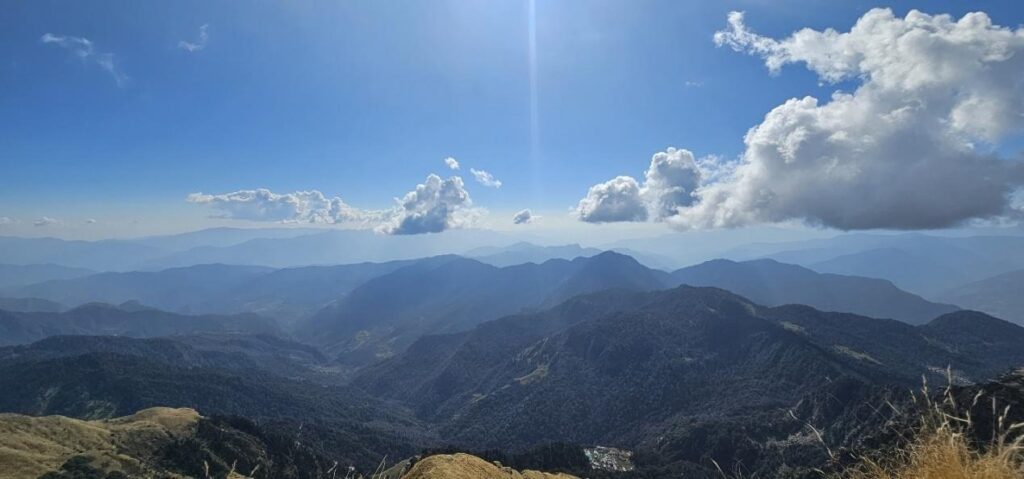
At 6 a.m., my alarm would go off in João Pessoa, Brazil. On rehabilitation days, this meant rushing to the rescue center to prepare enrichment experiments before the capuchin monkeys’ (Sapajus spp.) breakfast was served. By the time the sun was up, the humid air already hummed with insects, and I knew the day would be demanding. But demanding days were nothing new; during my previous fieldwork in the Indian Himalayas, I traded the enclosures for the forested mountains and valleys surrounding Mandal Village, where my colleagues and I would sometimes spend hours searching for and then watching a wild group of Langur monkeys (Semnopithecus schistaceus).
For nine months, I lived in these two worlds: one shaped by human care, the other ruled by monkey social dynamics. What struck me most was not the contrast, but the thread of resilience that tied the monkeys together.
My Time at the Rescue Center (June-August 2025)
We would arrive at the rehabilitation center by 7:30 a.m., oftentimes greeted by the calls of the group nearest the entrance. It took me a week to realize that these vocalizations were not random. They had learned to recognize our arrival, much like they did the caretakers who looked after them.Our main task was simple in principle but essential for their future; teaching the capuchins how to use stones as tools. In the wild, robust capuchins crack open hard palm nuts (e.g. Acrocomia aculeata) using stones as anvils and hammers. This was no small feat; many individuals were ex-pets or had been rescued after being injured, including one individual who was blind and others who were missing fingers. Some arrived at the center visibly stressed, yet we moved forward with the goal of teaching them to crack open the palm nuts with stones. To mimic this, we set two large stones inside each enclosure and gave the monkeys smaller hammer-like stones alongside macaíba nuts, whose pits (and outer shells) required cracking. At first, many of the monkeys ignored the setup or played with the stones and nuts, but gradually some began to use them as intended, especially as we progressed in our rehabilitation trials. Over time, the stones wore down under constant pounding and scraping and needed replacing, a sign of progress (we hoped).
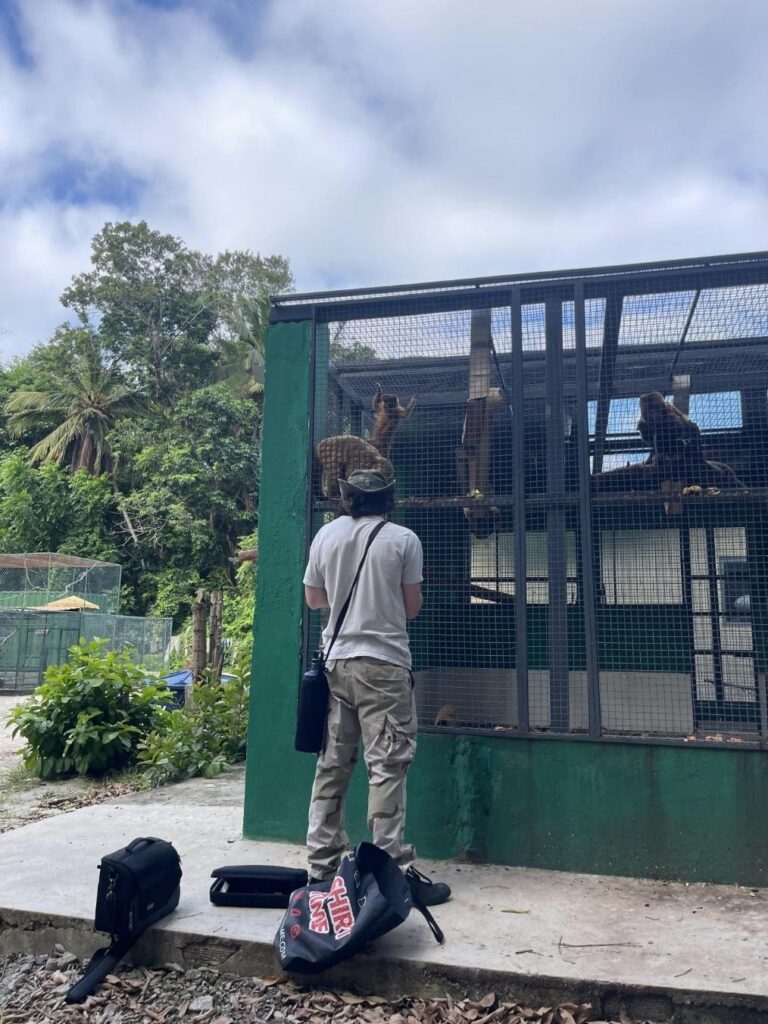
Their diets were diverse and carefully managed. Staff fed them everything from bananas and grapes to carrots, sweet potatoes, and kiwis, alongside specialized monkey kibble. For our experiments, though, we focused exclusively on macaíba nuts. The nuts were a challenge, and challenge was the point. These nuts are eaten in natural conditions when the easy to access fruits are hard to find. They are the highly nutritious food that the monkeys must be able to fall back on in times of food scarcity, once they are released into the wild.
Life at the rescue center was not only about food. Cleaning days, on Mondays and Thursdays, meant no data collection in the morning, giving us a chance to sleep in or plan for the future phases of the experiment. Some days brought unexpected drama. A tarantula once wandered into an enclosure, promptly escorted out with a fishing net by a quick-thinking caretaker. Another time, a large blue beetle with one of the most painful stings in Brazil flew into a group’s space, only to be smashed by a male, Galego, wielding a stone, as if the bug were a macaíba nut.
Though I was always close to the monkeys, I was never allowed to touch or feed them. My role was observational, and to prepare food and tools, while the caretakers entered the enclosures to feed, clean, and provide the enrichment. It was a calm place, surrounded by green forest, filled with alternating bouts of quiet and calls of many animals. Despite the controlled environment, the resilience of the monkeys, many of whom were ex-pets or had been injured, was unmistakable.
My Time in the Garwhal Himalayas (July 2023 – January 2024)
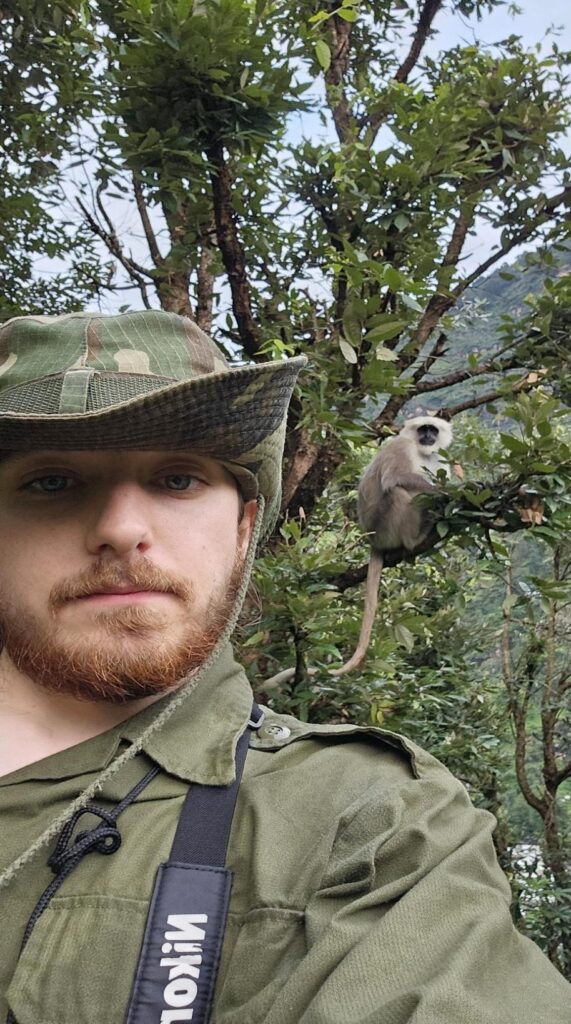
After completing my undergraduate degree, I joined the Himalayan Langur Project as a volunteer field assistant to help track the group’s movement and assist a PhD student, Virendra, with data collection for his thesis. We aimed to understand how these monkeys utilized their habitat and the drivers and patterns behind their navigation. Finding the langurs each morning often meant going to where we saw them go to sleep the night before. Our guides, Suraj and Mohit, met us in different parts of the valley depending on where we last left the group. If the langurs had spent the night higher up the mountain, closer to Suraj’s village, we headed uphill. If they were nearer to Mandal Village, Mohit would take the lead. On good days, villagers pointed us in the right direction. On harder days, we climbed onto the roof with binoculars, scanning the slopes for langurs or for farmers chasing them out of their fields.
Compared to the capuchins in Brazil, who were always waiting for us in their enclosures, the langurs demanded patience. Their home spanned steep mountainsides, forest paths, farms, and village edges. At first, reaching them meant adjusting quickly to the altitude, the cold, and thin air. Some mornings were straightforward, a climb up stone steps along the Forest Chawky path. Others required hauling ourselves up slippery slopes in the Kunkuli Forest, gripping roots and saplings to avoid sliding backward down the mountain.
Once we found them, the pace of the day depended heavily on season and weather. In winter, mornings were slow. Langurs often sunbathed for long stretches, conserving energy before feeding. In summer, the day started fast. If we were not with them as the sun hit the group, they were already gone, moving quickly between feeding sites. During these periods, keeping up sometimes meant running uphill through the slippery forest as they traveled from one fertile patch to the next, including farms where crops were ripening. Once they happened upon ripe lemons or other fruits, they started to travel towards the other fruit patches, which were also ripening at the same time.
Diet shaped much of their daily rhythm. In colder months, they fed primarily on leaves and whatever forest foods remained, which encouraged longer resting periods and tighter huddling. In warmer seasons, fruit and crops became more important, and the group spent much more time moving, feeding, and navigating the boundaries between forest and farmland. On days marked by cold or rain, the group’s activity was more contained, whereas clear, warm days were associated with more extensive movement through their range.
Socially, the group was large, reaching nearly seventy individuals, and highly coordinated. Some adult males appeared to take on consistent defensive roles. One male, Julio, was known for confronting dogs, while another, Hari 2, often lingered at the rear of the group as they moved. There were clear dominance hierarchies, with some individuals more deeply embedded in the group and others more vulnerable to being kicked out. Infants and juveniles were generally well cared for, but life in such close proximity to humans carries real risks.
We witnessed injuries and deaths. In one case, a female was pushed during a conflict while carrying her infant, who fell and died. She carried the body for weeks afterward before dogs eventually took it. In contrast, others survived severe injuries. One juvenile, Dawg, was attacked by a dog but was fiercely defended by an adult male, Gichu, who positioned himself between her and both people and dogs as she struggled to keep pace. By the time I left months later, her wounds had healed, and she was more than able to keep up.
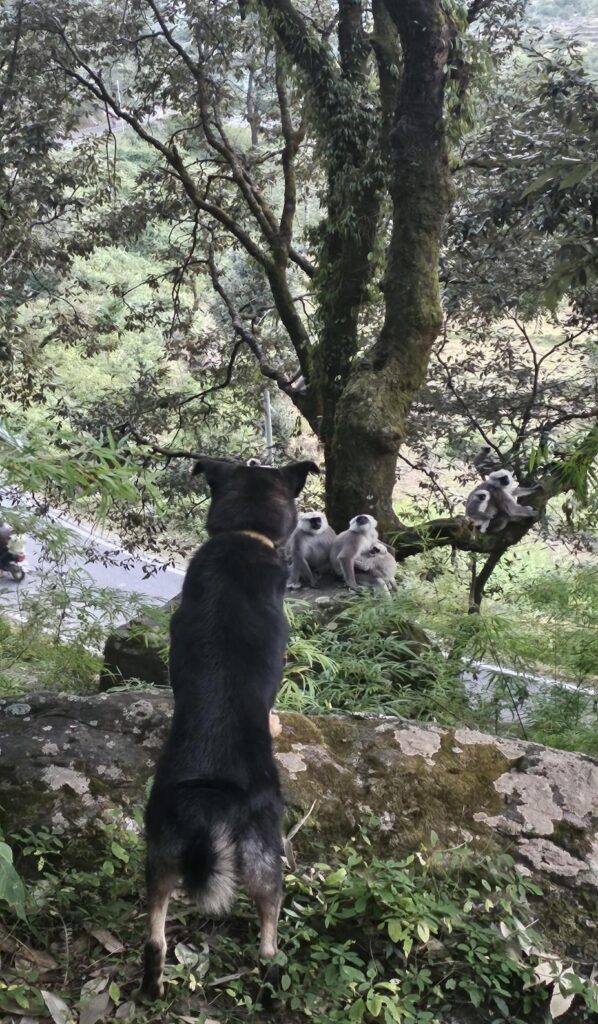
Human presence was constant. Villages, roads, and farms bordered nearly every part of the langurs’ range. While langurs are religiously significant in the region, they were also seen as a threat to livelihoods. The group learned to navigate this tension carefully. People were largely treated as a threat, and the langurs kept their distance accordingly, although our continued presence as researchers was eventually tolerated. The langurs would often forage on crops, and during these crop foraging episodes raids, their movements suggested coordination, with some individuals drawing attention while others fed.
Fieldwork in the Himalayas was physically demanding. We worked up to twelve hours a day, six days a week, often on steep, wet terrain. Cold temperatures, sharp vegetation (which was not fun to grab onto accidentally), and the constant risk of getting lost added to the challenge. One day, after taking a wrong turn and climbing far above the rest of the team, I watched a leopard chase a musk deer up the path less than fifteen feet from where I stood. Thankfully, it never noticed me, but moments like that leave a lasting impression of how much danger exists in these landscapes.
Comparing the Two Worlds
In both Brazil and India, my role was observational, but the context shaped how that observation unfolded. At the rescue center in Brazil, the capuchins were accustomed to humans. They recognized routines and responded to familiar staff, even attempting to engage with us despite the physical barriers. In the Himalayas, the langurs tolerated our presence but remained alert and responsive to every shift in sound or movement. Firecrackers, people yelling, and dogs barking all could send them fleeing to a new location.
What united these experiences was resilience, expressed in very different ways. The capuchins in rehabilitation were rebuilding lost skills, adjusting to social groups, and recovering from injuries or stress caused by captivity. The langurs, by contrast, were maintaining their way of life under constant pressure from shrinking habitats, human conflict, and environmental risk. One group was learning how to return to the wild. The other was actively negotiating survival within it.
Why Both Matter
Rehabilitation exists because habitat protection can fail. Many capuchins arrive at rescue centers as former pets or injured individuals, victims of deforestation and wildlife trafficking. Rehabilitation allows them to recover socially and behaviorally, increasing their chances of eventual release.
The langurs illustrate the other side of conservation. They are not waiting to be released. They are already there, adapting daily to human-dominated landscapes. Protecting habitats, managing human-wildlife conflict, and supporting coexistence are what determine their future. Without intact forests and tolerance, even the most resilient species will struggle.
What I Took Away
Living in these two worlds showed me that conservation must operate at multiple scales. At the rescue center, success depended on individual needs. A blind capuchin required a familiar enclosure yet would never be released into the wild. Others needed tolerant companions or targeted enrichment to build critical skills. In the Himalayas, success was collective. The langurs’ survival depended on coordination, vigilance, and the ability to navigate human-dominated space together.Across continents and species, the overall lesson was the same. Animals are remarkably adaptable, but behavioural plasticity and flexibility has limits. Resilience can carry a population far, but it cannot replace protected habitats, thoughtful management, and responsibility for the pressures we create. If we want these species to persist, we need to support both recovery and coexistence, as well as the biodiversity in the ecosystems they depend on, not one at the expense of the others.
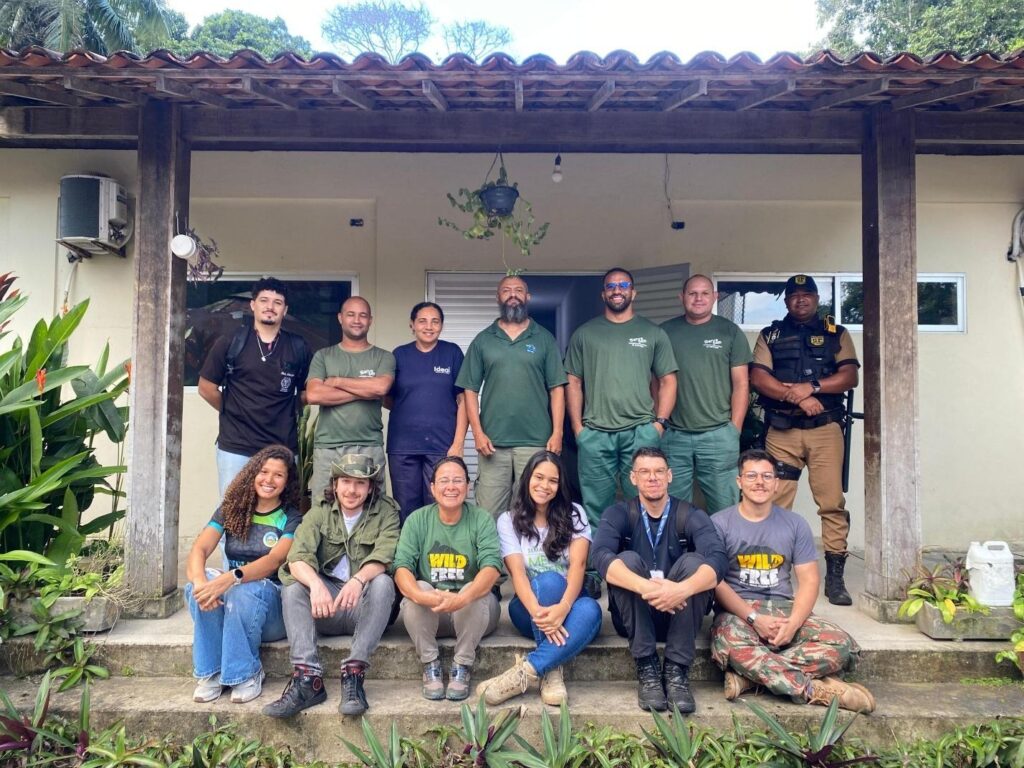
About the Author:
I am an MSc student in the PIES lab at Concordia University in the department of Geography, Planning, and Environment. My research focuses on primate rehabilitation and understanding a specific protocol’s effectiveness at improving welfare and teaching skills to help facilitate the release of capuchins into the wild. I am thankful for QCBS for helping to fund part of this research with their Excellence Award. My time in India was spent after graduating from the University of Calgary with a BSc in Biological Anthropology, in which I assisted a University of Toronto PhD student, Virendra Mathur, with his data collection at the Himalayan Langur Project.
My Instagram: @UraPrimatologist, X: @UraPrimate
OperacioSapajus Instagram @operacaosapajus
PIES lab Instagram: @PIES_Lab_ConcordiaHimalayan langur Project: www.himalayanlangur.com Instagram: @thehimalayanlangur


0 Comments