By Rachel Bergeron, PhD candidate at l’Université de Sherbrooke
I landed my first Biology internship in my second year as an undergraduate student. I spent that entire summer running around Gatineau Park, looking for endangered fauna and flora, and monitoring populations of invasive plants. I could not believe anyone would be willing to pay me to hike all day, stopping every 10 meters to identify a plant or bird of some kind (a habit that annoys my non-biologist friends and family greatly). I have followed that love for biology and fieldwork ever since. It has led me to Arizona to chase lizards, Ontario to chase mice and chipmunks, the Canadian Rockies to chase bighorn sheep, and Australia to chase kangaroos as a doctoral candidate.
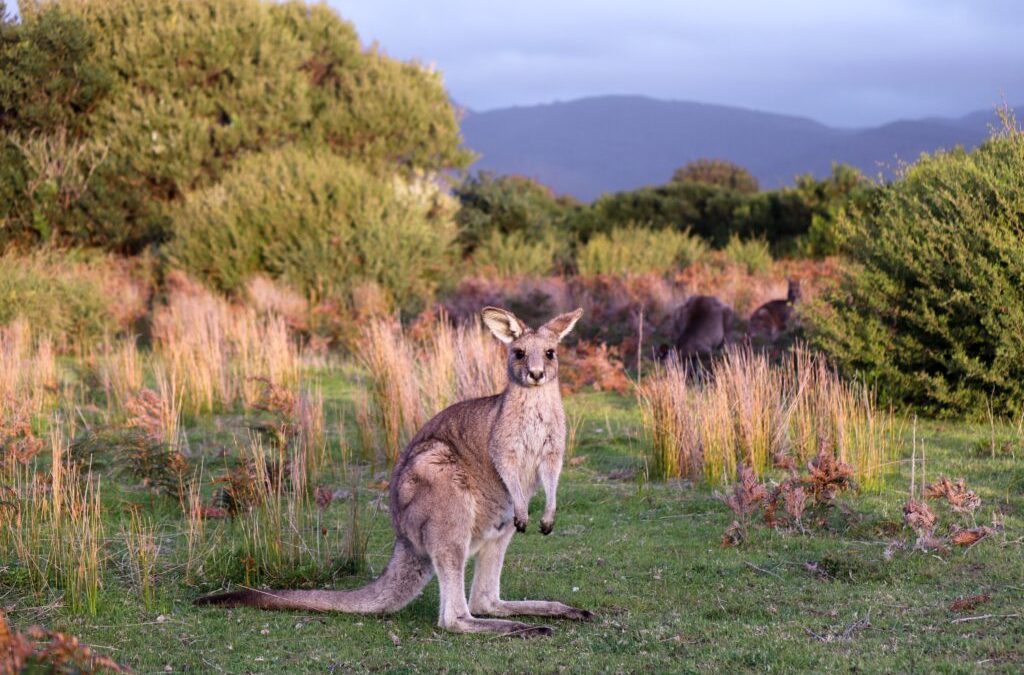
I was lucky enough to join a long-term research project monitoring a wild population of Eastern grey kangaroos in one of Australia’s most popular national parks, Wilsons Promontory National Park in Victoria; a project that came with the fieldwork of my dreams. It involved living at Wilsons Prom in a research station a few minutes away from some of Australia’s most beautiful beaches, and walking among and capturing kangaroos most days. Kangaroos are crepuscular, meaning they are active around dusk and dawn much like our white-tailed deer. Fieldwork was therefore conducted in two 3-4 hour sessions per day, from a little before sunrise to a few hours past sunset. During this time, one of us conducting fieldwork would be capturing kangaroos, while the other would be observing them. We would take note of which kangaroos are still alive, which ones have young, which ones are hanging out together and where, which males are winning fights, and so on.
Now how does one capture a 2 meter tall, 70-kilogram kangaroo with 2-inch claws and a kick you do not want to be on the receiving end of, you may ask? The answer is drugs. While you may be picturing a dart gun, the approach our team has been using for 16 years is far more creative. It involves a syringe affixed to a 6-meter window cleaning telescopic metal pole, aimed at kangaroo bums. It allows us to sedate the kangaroos for an hour or two so we may weigh them, measure their legs and arms, check their pouches for young or lactation, check the condition of their eyes and teeth, and make sure they are generally in good health. It also gives us the chance to mark them with unique combinations of colourful collars and ear tags, so that we may observe them from a comfortable distance for the years to come. Each kangaroo is caught at most once a year, and only studied via binoculars otherwise.
I think my favourite aspect of fieldwork is the opportunity it provides to discover the environment you work in, whether it be your home ecosystem or a new one, up close and personally. Boy, did Australia provide a new environment to discover. Its biodiversity is so different to the one I know best in Southern Quebec. The entirety of its fauna and flora were new to me, aside from the occasional (incredibly destructive) invasive species such as red foxes, feral cats, and European rabbits. How surreal it was to walk through grassland among kangaroos, wallabies, wombats and emus, with flocks of incredibly colourful and loud cockatoos and parrots flying above. To conduct fieldwork in the complete darkness of the night and not worry about bears or cougars, only about falling into the holes dug by wombats in the ground, sometimes a few feet deep. By the end of the field season, we were able to recognize nearly a dozen species of marsupials, invasive mammals and nocturnal birds from only the colour and shape of their eyes reflected in our headlamps. On a nice dry night, the ground often seemed to glitter from the light of our headlamps reflected in the eyes of thousands of (harmless) spiders.
While some of us tend to see Australia as the land where everything is out to kill you, I was quite surprised to find out Australians have the same vision of Canada! Whenever I would mention home, they would inevitably hit me with “Oh my goodness, the land of bears, wolves and cougars!”. I would then remind them of their dozens of deadly snakes and spiders, not to mention crocodiles, sharks and jellyfish.
My fieldwork in Australia is now complete. This summer, 2024, was the first I spent at home in a few years. This fieldwork has been especially meaningful to me. I joined the project team in January 2020, meaning that a certain pandemic made me wait patiently for my opportunity to fly over to the land of the kangaroos. More than once, I planned a field season, sorted visas, booked flights, and had to cancel everything as a new wave hit. By the time I finally landed in Sydney, what had started out as an MSc had turned into a PhD and I had been studying a creature I had never seen, for over two years. Thankfully, the wait was well worth it!
About the author: Rachel is a doctoral candidate researching the population dynamics of kangaroos under the supervision of Marco Festa-Bianchet at the Université de Sherbrooke and Dave Forsyth at the New South Wales Department of Primary Industries. She is interested in the interacting roles environmental conditions and population density and structure play in population survival, recruitment, and ultimately growth rate, as well as in the impacts of park visitors and road mortality. She is also a QCBS global representative and vice-president of the UdeS’s Collectif Féminiscience.
By Benjamin Mumford, MSc student at l’Université de Montréal
Having recently arrived in Canada to start a master’s in Marine Biology, a departure from my host city of Montreal and the St. Lawrence was imminent to find the more salty water – both to conduct my field seasons and to take more specialised, degree-focussed courses. The awarding of the QCBS Excellence Award provided a unique, immersive opportunity that has profoundly impacted my continued research, and crucially, my own competencies at an early stage in my academic career.
Bamfield Marine Sciences Centre, located in the southern region of Barkley Sound (BC) within the traditional territory of the Huu-ay-aht First Nations, is a world-leading marine station run by a cooperative of five western Canadian universities. Pioneering research has been conducted and continues to emerge from what was once the Pacific Cable Station and has now been a bustling (miniature) campus on the east side of Bamfield village since its creation in 1972. The west side of Bamfield is only accessible by boat and swells in population during the summer fishing season, but provides an escape to students looking to get out of campus at the end of the week, offering multiple bays to explore, or two restaurants that are now open.
More crucially for me however, the station offers the only dedicated intensive (3-week) course that results in the awarding of a scientific diving qualification from the Canadian Underwater Association of Scientists (CAUS). Led by an exceptional instructing team, the Subtidal Science Course runs biannually and exposes students to the world of scientific diving in an authentic way.
In the class of 2024 was a wide range of individuals from both academic and diving perspectives, ranging from undergraduate to PhD students, and commercial divers to those that only recently started recreational diving. As a result varying degrees of diving experience, context and ability started however all emerged CAUS level 1 scientific divers.
Eventual arrival into the village of Bamfield followed a multi-day transit form Victoria with an early morning ferry along the Alberni inlet on board the MV Frances Barkley. Prior to the paving of the logging road from Port Alberni, the ferry has been the primary and traditional way of contact with the “outside world” for this west-coast village for many decades. With the class cohort arriving on Monday, orientations and introductions occurred over dinner before an early first night. Preliminary lectures the next morning and checkout dives in the afternoon ensured the long list of equipment and basic physical capabilities were present and up to standard. With the fundamental skills commonly found in the recreational world of diving practised and assessed, a transition into more observational and scientifically-orientated dives followed the next day.
Something I was not prepared for was the abundance of life in Barkley Sound. My anticipation to dive the west coast of Vancouver Island was running at an all-time high prior to my arrival, given the many jealous remarks and recommendations I had received, along with the reminder Jacques Cousteau had listed the Sound as the second-best place to dive in the world. The diversity, density and size of organisms was incredible. What was particularly pleasing was the number of echinoderms present, the focus of my own research, and what I would be coming back to study over the rest of the summer.
A typical underwater scene – numerous invertebrate species and plenty of those with backbones too!
Within a few days our knowledge of dive theory, safety and physics were tested through written examination and with everyone passing, the class was subsequently moved to the status “diver’s in training”. Now, the skills and proficiencies that are required in the world of scientific diving could be properly taught and tested. A number of instructor-led dives constituted the remainder of the week, testing underwater skills that ranged from fish and invertebrate ID, to practising surveying techniques, measuring abundance, organism sizing, habitat rugosity and species coverage. What was noticeable was the exponential increase in my “regular” diving skills. With such high task-loading and other things to be concerned about, the skills that often consume your mind in a recreational dive quickly become refined and of second-nature.
Another week of instructor-led tasks followed the near daily routine of:
•0730 Breakfast
•0830 push off from the dock with 2 morning dives
•back for a 1230 Lunch and tank refills
•1400 push off again for a further 2 dives,
•back for 1800 Dinner, with gear disassembled and logbooks filled out
•2000 evening lectures ready for the next day
Group discussions dictated the direction of the student project
From the course midpoint the scope of our training transitioned, as a student-led project crystallised. Evening lectures gave way to discussions determining what questions could be tested by the group as well as the methods and planning that was required to complete such an underwater task. One thing that remained prevalent throughout the course was the attention to detail in safety. Dive plans had to be carefully constructed, safety techniques and procedures clearly detailed, and the confidence of everyone in being able to complete complex tasks to a high scientific standard whilst never compromising diver safety. Inevitably greater flexibility than was already built into the project proposal was required with factors such as storms, malfunctioning equipment and the physical condition of divers all compounding any issues that unavoidably arise in an intensive course.
Our class project was looking at the effectiveness of underwater survey method types in capturing Northern Abalone populations, something of great cultural importance and in turn led to a very positive and exciting atmosphere. The project was a great success with dozens of sites surveyed and some exciting results that culminated in the submission of a final report on the last day.
The ultimate goal of becoming a scientific diver was to provide myself the capabilities and freedom to conduct my own research – looking at the evolutionary development of the echinoderm skeleton. As a now qualified CAUS diver, I can collect specimens through SCUBA at institutions across Canada. This crucial connect between field and lab work enables for a greater understanding of organisms in biology. Through personal collection, specimens of notable interest, such as sea stars with regrown limbs, or access to juvenile stages developing in their natural environment, as well as individuals found in unique settings and ecosystems that simply can’t be replicated when cultured in a lab environment are captured. This context only strengthens understanding of development and evolutionary biology and, in my case, how echinoderms have come to play such an outsized role in marine ecosystems.
Throughout both the instructor and student-led components of the course my appreciation of the level of detail in scientific diving, including the preparation and huge amount of other work that goes into obtaining such data was consistently apparent. I am incredibly grateful to the instructional team, BMSC staff and those in the course for making it such a rewarding and formative experience for myself.The skills and opportunities it has provided me for my own research has prepared me well for a career in marine science. Without the support of the QCBS Excellence Award this experience would not have been possible, with the course of my Masters also looking very different. I would therefore like to reiterate my gratitude to the society in the awarding of the funding that enabled this experience a possibility to start with.
Diving in rather “soupy” water of Barley Sound, BC
About the author: Ben Mumford is a MSc student at UdeM in the Cameron Lab. His work is looking at the evolutionary development of the echinoderm skeleton. This will primarily be achieved by investigating the chemical composition and microstructure of individual ossicles with the hope of illuminating the evolution of biomineralized structures in the ambulacrarian lineage.
One of the most fun and rewarding things you can do in grad school is start a side project with your fellow grad students. It’s a chance to dive into something you’re passionate about, build your skills in developing methodology, planning experiments, and really start thinking like a scientist—all without having to rely too much on your supervisor.
If you need funding, there are plenty of grants out there that you can apply for. For example, you can apply for the QCBS excellence award, the Graduate Research Excellence Grant Rosemary Grant Award through the Society for the Study of Evolution, or the Langhammer Fund which offers funding for projects involving livebearing fish. Applying for these grants can also give you hands on experience in grant writing, which is a very useful skill. My friend Alexis Heckley and I started a side project to investigate that we managed to get funding for from two different grants. We even approached a professor to chip in some funds in exchange for taking two of his students along on our trip to gather data for their theses.
In February 2024, we headed to Trinidad and successfully pulled off our field experiments. Our project aimed to investigate how researcher sampling could be impacting Trinidadian guppy populations. To do this, we collected guppies from highly sampled and lowly sampled sites and then measured length and mass, several different behaviours, and male colouration. We are currently working on the data analysis to identify any differences in these traits that may be driven by researcher sampling.
Showing Alex Berger what a guppy looks like.Trapped in a mud pit … I survived!Alex is hungry for guppy snacks.Science is held together by hot glue guns and tape. Alex and Megan Cyr.Alexis taking the most direct route possible to our field sites.Collecting guppies.Alexis looking very cool with the machete.Even had time for a day off!
This whole experience not only gave me the confidence to tackle research projects on my own but also helped me build all the skills I’ll need to be an independent researcher. If you’re in grad school and thinking about doing a side project, I say go for it—it’s totally worth it!
About the author: Janay Fox is a PhD candidate in Dr. Rowan Barrett’s lab at McGill University. Her PhD research primarily investigates the epigenetic mechanisms of behavioural plasticity in Trinidadian guppies. She is also passionate about outreach and has co-founded the Asokan project, an initiative to provide educational resources to rural and Indigenous youth in Saskatchewan.
By Jackie Hamilton, PhD Candidate at McGill University
Have you ever been to a conference where a compelling storyline emerges from seemingly unrelated research? I wanted to capture three storylines from my experience at the International Union of Forest Research Organizations (IUFRO) World Congress. I present them here as scenes in a movie. While this did take place right after the Swedish Midsommar Festival (popularized in North America by the Hollywood horror film), there was nothing scary about my experience. In fact, I felt a sense of relaxed connection with other forest researchers, even within such a massive research congress.
We open with a wide shot of the welcome ceremony at IUFRO. Nearly 5000 people from all over the world are seated in this room and a sense of anticipation looms. Swedish folk musicians begin on stage, playing wooden instruments from local forests while imagery of Swedish forests plays behind them. We move from this massive conference center in the city to a protected forest south of Stockholm. Here, a more intimate group of 20 scholars move through the forest from one outdoor research poster presentation to the next, snacking on blueberries we’ve foraged along the way.
In Sweden, by law “everyone shall have access to nature in accordance with allemansrätten“. Allemansrätten, translating to “the everyman’s right” is the right to walk and gather plants on land regardless of property ownership. We learn from a graduate student presenting on climate justice social research that the majority of Swedish people embrace this right and frequently visit forests. While there was a lot of pride in this equitable access to forests, there was also a recognition that, especially with some industrial forestry practices, there remain inequities in terms of who benefits from the forests. This is especially true for industrial practices like clearcutting, which can conflict with multifunctional values e.g. recreational and foraging also associated with forests.
We feel a strong sense of connection between Swedish people and the forest, though tensions between forest actors are highlighted in the research themes of the conference.
This scene opens with the keynote talk from Dr. Juliette Biao, Director of the United Nations Forum on Forests Secretariat (UNFSS) (and a fellow Canadian). Dr. Biao highlights the ties between the empowerment of women and forest resilience. We move back from the congress building to the forest south of Stockholm, where we hear from a collective of women forest owners about the challenges they have faced as women working in a male-dominated industry and the power they have found in starting a collective. Another collective of (mostly) women researchers fills a small room at the conference center for a session on feminist theories of care in forestry. ‘Care’ encompasses diverse understandings and practices of caretaking. Care is an “important means of understanding how people relate to the world, and the relationship between people and trees is no exception” (O’Flynn et al. 2021: 228).
As Dr. Juliette Biao highlighted in her keynote, women are underrepresented in forestry but are more likely to fall into the category of forest-dependent populations globally. While allemansrätten secures access rights to some benefits from forests, we heard from the Swedish Women Forest Owners that only 13% of forests are owned by women alone in Sweden, a much smaller percentage than men. There have been many shifts in discussions of gender in forestry over the last few decades, led largely by women like these presenters, who are pushing the conversation forward. However, in the session on care, the question as to why it is so skewed toward a women audience is raised by one of the only men in the audience. The empowerment of women and the concept of care are not topics of exclusive interest to women. In the session on care, PhD candidate Tuulikki Halla gave a talk describing how professional foresters (inclusive of all genders) in Finland both care for and feel care from forests in not just professional, but deeply personal ways. Care for forests is not unique to one gender or worldview, but as these talks illuminate, more diverse perspectives can make visible some of the emotions, histories, personal experiences, and other ways of understanding that can play important but under-emphasized roles in decision-making and conflict in forests.
Our final scene opens in the massive exhibition hall, where much chatter makes it hard to listen deeply. However, we are still drawn to a talk by Dr. Heidi Rautiainen on her PhD research looking at Sámi reindeer husbandry, specifically on the impact of winter feeding, which is increasingly seen as a necessary climate change adaptation. We move back into the forest for a talk by Karin Nutti Pilflykt with the Saami Council and Tim Horstkotte, Umeå University, who tell us about the intricate connections between forest management practices, lichen availability, reindeer feeding, and Sámi rights. Industrial forestry practices, including dense tree planting, have changed the habitat for lichen, a critical food source for reindeer in Sápmi, the traditional territory of the Sámi. The scene ends with a presentation from a fellow Quebec PhD student, Laurence Boudreault, at Laval University, speaking about the W8banaki Nation’s forest stewardship and the challenges of adaptation for a cultural keystone species, Black Ash, associated with the largely privately owned landscape in their Territory.
Research with the Sámi of Sápmi and the W8banaki of Ndakina present different but shared challenges associated with colonization and global challenges (climate change and the Emerald Ash Borer) which are threatening cultural keystone species.
This scene ends on a note of hopeful collaborations between Indigenous communities initiating and leading research and academia to help discover potential routes forward for adapting practices and upholding responsibilities to relations like reindeer and ash. Read more about the reindeer feeding project here and the black ash project here.
Credits:
I’m incredibly grateful to QCBS for the excellence award and NSERC ResNet HQP mobility awards that allowed me to attend this conference. It was an amazing experience that has expanded my understanding of how diverse but connected forest issues are globally.
About the author: Jackie Hamilton is a PhD candidate at McGill University in the Social Ecological Workshop (with professor Elena Bennett) and the Northern Wildlife Knowledges Lab (with professor Murray Humphries). Jackie is studying peoples’ relationships to trees in the Mont Saint Hilaire Biosphere Region, to contribute new ways to assess and account for more of the diverse values associated with trees.
By Marie Launay, PhD candidate at McGill University
With the generous support of the QCBS Excellence Award, I had the privilege of attending the annual conference of the Conservation Society of Ecology and Evolution (CSEE) in Vancouver from May 26 to 29, 2024. This conference brought together a diverse group of ecologists and evolutionary biologists from around the globe to share their latest research and insights.
Wreck Beach near the UBC campus.
At this conference, I presented the first chapter of my PhD project which assesses the relationship between the density of gill rakers and the diet of Arctic cod. Presenting my findings to experts in the field was a valuable experience that allowed me to engage in thoughtful discussions and receive constructive feedback, helping to further develop my research.
Presenting my results on the Arctic cod diet at the CSEE conference.
The conference featured a wide range of presentations that broadened my knowledge, including those on population genomics, evolutionary biology, species adaptation, and conservation strategies. Attending these sessions deepened my understanding of current ecological challenges and potential solutions.
One of the most rewarding aspects of the conference was the opportunity to network with a wide array of scientists at different stages of their careers. These interactions provided fresh perspectives and potential collaboration opportunities, enriching my academic experience.
Aside from the conference activities, exploring Vancouver was a highlight of my trip. As an international student, I found the city’s vibrant culture and stunning natural scenery truly captivating. I visited iconic spots such as Stanley Park and Granville Island and took in the breathtaking views of the surrounding landscapes. These experiences added a memorable personal dimension to my professional journey.
Downtown Vancouver.A little walk in Stanley Park.
The QCBS Excellence Award not only facilitated my participation in a pivotal professional event but also allowed me to experience the unique environment of Canada’s west coast. This experience has been instrumental in shaping my research outlook and has provided me with valuable connections and insights for my future work.
About the author: Marie Launay is a Ph.D. candidate at McGill University, under the supervision of Dr. Denis Roy. She works on population genomics of the Arctic cod. She has always had a passion for marine ecosystems. She received her B.Sc. in Biology from Sorbonne University at Paris, France; her first M.Sc. in Systematic and Evolution from Sorbonne University and National Museum of Natural History at Paris France; and her second M.Sc. in Integrated Coastal Management and Fisheries Valorization at Pascal Paoli University at Corte, France.
Une discussion avec des personnes qui pratiquent la recherche multidisciplinaire impliquant l’étude de sociétés humaines et la gestion de ressources naturelles.
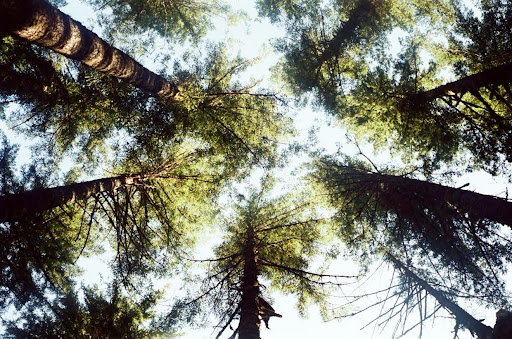
Forêt dans l’Oregon, USA photographie par Marie Saydeh, juillet 2023.
Qu’est-ce que la recherche multidisciplinaire ?
Tout simplement, c’est d’utiliser diverses spécialités en parallèle au cours de la réalisation d’un projet scientifique. Pour mon doctorat, je fais intervenir différentes disciplines afin de répondre à ma question de recherche. Pour le pitch explicatif de mon projet, je dis souvent que je fais de la recherche en socioécologie et en gouvernance environnementale. À première vue, ce sont des sujets qui ont l’air fascinants ! Mais, d’un autre point de vue, je me dis que cette explication doit être énigmatique et légèrement spécifique.
En pratique, je suis amenée à maîtriser des notions d’anthropologie, de géographie humaine, de biologie, d’agroforesterie, de psychologie, des sciences politiques… Bref, j’élabore un vrai bricolage disciplinaire !
Avec mes collègues de l’Université Laval, des personnes aux cycles supérieurs et des professionnel.le.s de recherche, nous sommes plusieurs à faire de la recherche scientifique multidisciplinaire sur des thèmes impliquant l’étude de sociétés humaines. Pour la rédaction de cet article, j’ai voulu m’intéresser à nos expériences et j’ai demandé à ces collègues volontaires de remplir un questionnaire de 15 questions. Je vous partage dans les lignes qui suivent, les résultats et des réflexions personnelles sur le sujet.
Quel est le rapport de mes collègues à la recherche multidisciplinaire en milieu académique ?
Selon les résultats obtenus, mes collègues effectuent de la recherche impliquant diverses disciplines dès la conception de leur projet et dans l’analyse des données. Ceci leur permet de répondre adéquatement à une question de recherche, impliquant l’étude de sociétés humaines dans la gestion de ressources naturelles.
Je me suis ensuite intéressée à leurs perceptions des systèmes de financement à l’égard de la recherche concernée. Les personnes ont plutôt des impressions dans les tendances négatives. Iels ont mentionné que « parfois », voire « aucunement », ce type de recherche était favorisé.
Je leur ai également demandé quels seraient les types de recherche qu’iels voudraient pratiquer dans un monde idéal où les ressources leur seraient accessibles. 33,3 % demeureraient dans le multidisciplinaire, tandis que 55,5 % iraient vers le pluridisciplinaire (utilisation de différentes expertises vers un objectif commun) ou le transdisciplinaire (connaissances formulées au-delà de disciplines strictement distinctes).
Les valeurs personnelles des chercheur.euse.s, ont-elles un rôle à jouer ?
J’ai demandé à mes collègues s’iels aimaient faire de la recherche multidisciplinaire. 83 % ont répondu que oui. Les 17 % restants ont justifié des éléments qui, selon moi, touchent à des notions qui mériteraient d’être approfondies ultérieurement. Certain.e.s ont répondu qu’iels préféreraient travailler dans une seule discipline. D’autres voudraient plutôt faire de la recherche transdisciplinaire, c’est-à-dire d’intégrer des connaissances au-delà de la division de certaines disciplines.
Je me demande donc : existerait-il un besoin, chez les chercheur.euse.s concerné.e.s, de décloisonner des connaissances, ou du moins de reconnaître ce type de recherche dans sa valeur intégrale ? Pour le milieu académique, la recherche multidisciplinaire n’agirait-elle pas parfois comme un compromis vers la transdisciplinarité ?
J’ai aussi demandé à mes collègues si la motivation personnelle jouait un rôle important dans la pratique de cette recherche. 55 % des collègues ont répondu qu’il faut être « motivité.e » ou « passionné.e » pour pouvoir pratiquer la recherche multidisciplinaire en lien avec les sociétés humaines. Or, 33 % ont répondu « pas forcément ». Le 11 % restant, à ma grande surprise, n’ont pas répondu à la question.
Je me suis donc demandé quelles étaient les motivations personnelles ou professionnelles de mes collègues. 88 % ont répondu que ce qui les motive à pratiquer, c’est, entre autres, de savoir que leurs recherches pourraient être utiles pour la société. D’autres motivations sont ressorties également, comme le fait de répondre rigoureusement à une question scientifique, de réussir à faire avancer un projet, de suivre le courant de la vie académique et même de se challenger personnellement.
À quoi sert la recherche multidisciplinaire ?
Lorsque j’explique ma recherche, je me retrouve systématiquement à devoir rendre accessible de nombreuses notions afin que mes interlocuteur.rice.s puissent à leurs tours suivre mes développements. Autrement dit, je dois aller rejoindre les personnes dans les concepts qu’elles connaissent pour exposer avec succès le sens de mes réflexions.
C’est dans ce sens que je me dis que c’est sûrement le rôle de la recherche multidisciplinaire, que de rejoindre les personnes dans les contextes qui les concernent ; tout comme de s’inscrire dans une situation vécue. Je me demande donc si le fait de pratiquer la recherche multidisciplinaire n’amène pas aussi à développer une expertise particulière; la capacité de naviguer entre les disciplines et d’entamer des discussions avec des divers acteur.rice.s, rejoignant des connaissances qui resteraient autrement isolées dans le vase clos d’une discipline.
La recherche multidisciplinaire impliquant l’étude de sociétés humaines, selon moi, sert à ce que les résultats s’inscrivent dans une situation authentique et que potentiellement ils puissent contribuer à fournir des informations utilisables aux personnes concernées par un enjeu.
Je tiens à remercier chaleureusement mes collègues de l’Université Laval qui ont répondu au questionnaire ou qui ont contribué à cette discussion avec moi. Je remercie, entre autres, Victor Beaudet, Yann Miassi, Mohamed Awalo Traoré, Benjamin Roy, Denis Blouin, Dieu Merci Domboli, Emmanuel Lokpaka Bafalata, Anne Bequeret et Alice Semnoun.
À propos de l’auteure : Marie Saydeh est candidate au doctorat en géographie à l’Université Laval. Elle a obtenu une maîtrise de l’Université de Sherbrooke et de l’Université de Liège en sciences et gestion de l’environnement, ainsi qu’un baccalauréat en biologie de l’Université d’Ottawa. Elle s’intéresse aux questions de nature transdisciplinaire et son projet de doctorat porte sur les constructions sociales de la biodiversité dans les actions publiques en agroenvironnement au Québec. Elle étudie comment s’organise la gestion de la biodiversité en agroenvironnement au Québec.