By Lucas Eckert, PhD Candidate at McGill University
Can you believe they have a whole conference just for some random species of fish? Well, you better believe it, because I was there. In fact, this wasn’t even the first time it happened – this was the 11th International Congress on Stickleback Behaviour and Evolution – and I’ll tell you all about it.
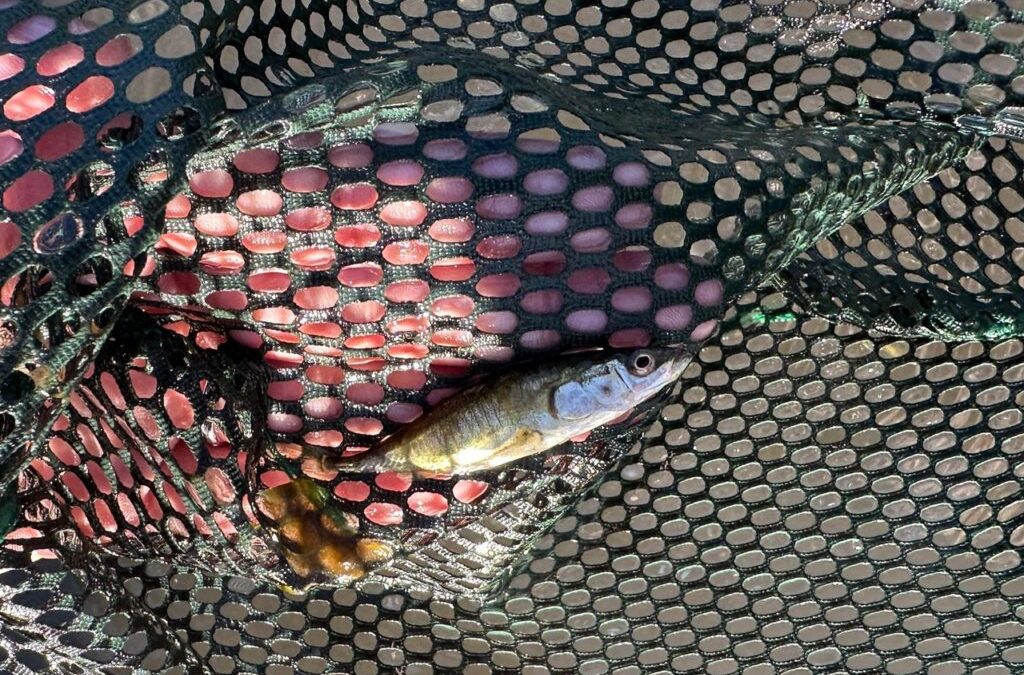
A charismatic marine threespine stickleback, caught early one morning at the conference
Of course, stickleback (threespine, to be exact) are not just some random species of fish. In the past 50 years or so, stickleback have become a model system in evolutionary biology. This is largely due to their unique evolutionary history and their propensity to colonize new environments, which has led to striking patterns of evolutionary divergence. And for the kinds of questions that I’m interested in – the predictability of adaptation, the mechanisms that promote phenotypic diversity, the factors that lead to speciation – stickleback are just the perfect little fish.
Every three years, the research community organizes a conference to get everyone in the same room and talking stickleback. This year, the conference was organized by Andrew Hendry (McGill), Katie Peichel (Bern), Sean Rogers (Calgary), Rana El-Sabaawi (Victoria) and Dan Bolnick (Connecticut) and was to be held at the Bamfield Marine Sciences Centre on the west coast of Vancouver Island. Andrew asked if I wanted to be involved as the head of the student organizing committee and I couldn’t say no to such an honour.
Bamfield Marine Science Centre, as seen by boat
Bamfield is a small coastal community on lands belonging to the Huu-ay-aht First Nations, just north of Pacific Rim National Park. It is also home to a field station that has been operating for over 50 years, facilitating research and hosting numerous field courses every year. Interestingly, they had never hosted a real conference at the field station, until this year. Sean Rogers is the current director at Bamfield, and an avid stickleback researcher himself, so luckily, we had an inside man to help set this up. I really can’t emphasize enough how amazing it was to have our conference at this location. The scenery was obviously stunning, we got to go out on hikes and boat outings and see some amazing wildlife, and we even got to go catch some stickleback. It was also very fitting as British Columbia was host to much of the seminal work on stickleback evolution, thanks to the likes of Don McPhail, Tom Reimchen, Dolph Schluter, and others, many of whom attended the meeting.
I would be remiss if I didn’t mention the virtues of having a rather small yet focused conference. There were ~100 attendees, which was the perfect number of people to meet plenty of folks without being overwhelmed. It also meant that you could just have a single session and wouldn’t have to run between rooms or miss people’s talks. The quality of the talks was exceptional, and the content was uniformly fascinating (though I may be biased). We also had some incredible plenary speakers and a very insightful set of talks from some of the pioneers in the field who got to reflect on their journeys and the state of the current research landscape. While large conferences like Evolution or the Ecological Society of America have their virtues as well, it’s hard to imagine beating the format of this meeting. Certainly, this was the most rewarding conference I’ve attended, a sentiment which was echoed by many attendees, even those who have surely attended countless conferences.
The main conference room during one of our evening plenaries. Photo from Dan Bolnick
I’m very grateful for the opportunity to have attended and helped plan Stickleback 2025. And I’m incredibly grateful to all the other faculty and student organizers and the staff at Bamfield for making it happen and making it so special. It’s surely not an experience I’ll forget anytime soon. There’s lots more to tell, including a tsunami alert and a late night encounter with bioluminescent plankton, but those are stories for another time.
About the Author:
Lucas is a PhD Candidate in the Department of Biology at McGill University, supervised by Rowan Barrett. For his thesis, Lucas is exploring population-level responses to new environments using a large-scale transplant experiment in Alaska (with stickleback of course). He likes travelling (to places with stickleback) and long walks on the beach (to hopefully find and catch some stickleback).
Par Thomas Villeneuve, étudiant à la maîtrise à l’Université de Montréal
Cet été avait lieu la conférence Botany 2025, à Palm Springs, organisée par la Botanical Society of America. SimonPesant et moi, deux étudiants du laboratoire de floristique d’Étienne Léveillé-Bourret, y avons assisté, en plus de présenter nos projets de maîtrise respectifs.
Nous avons pensé que, tant qu’à être en Californie, il serait intéressant d’aller explorer les milieux naturels, regorgeant de plantes endémiques. C’est pourquoi, après la conférence, nous avons loué une voiture et pris la route en direction du Nord. En Californie, il y a une chaîne de montagnes qui scinde le territoire en deux : la Sierra Nevada. Cette chaîne de montagnes s’étend jusqu’au Nevada et présente une grande diversité de paysages, et, par le fait même, de plantes qu’on ne retrouve nulle part ailleurs. Notre route s’est donc faite à l’est de la Sierra Nevada, et nous avons fait halte dans les petites villes de Bishop, Mammoth Lakes et Mono City. Tout au long de notre périple, nous avons utilisé l’application iNaturalist pour compiler nos observations de plantes et avons récolté des spécimens dans le but de bonifier la collection de l’herbier Marie-Victorin.
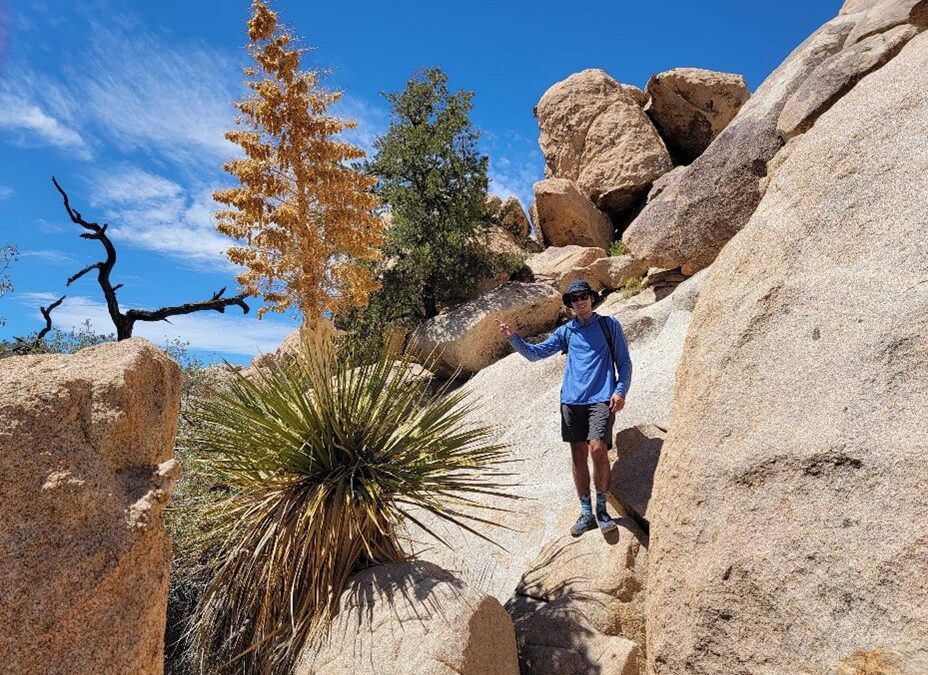
Visite du parc national de Joshua Tree situé près de Palm Spring, où se déroulait la conférence
Notre première sortie sur le terrain a donc été une exploration des zones alpines de la Sierra Nevada. Au cours de cette sortie, nous avons compilé plus de 60 observations sur iNaturalist et récolté plus d’une dizaine de spécimens. Ici, la route sillonne la montagne jusqu’à plus de 3 000 mètres d’altitude, ce qui permet d’accéder aux zones alpines sans trop déployer d’efforts.
Zone alpine dans la Sierra Nevada, à 30 minutes de route de la petite ville de Bishop
Le lendemain, nous avons exploré la forêt des pins de Bristlecone. Ces arbres, qui sont adaptés à pousser entre 3 000 et 3 400 mètres d’altitude, sont résistants aux feux et peuvent vivre jusqu’à 4 800 ans. C’était très impressionnant à voir.
Pins de Bristlecone (Pinus longaeva)
Nous avons ensuite pris la route vers San Francisco. Sur le chemin, nous devions nous arrêter au parc national de Yosemite, un incontournable de la région.
Selfie avec le mythique El Capitan dans le parc national de Yosemite
À San Francisco, nous avions deux objectifs : une sortie sur le terrain planifiée avec un botaniste local, puis une visite d’herbier.
Notre première journée, nous nous sommes donc rendus au point de rendez-vous convenu, un ranch un peu perdu dans une zone rurale. C’est là que nous avons rencontré Morgan Stickrod, un botaniste californien d’une trentaine d’années, avec qui j’ai eu l’occasion de collaborer dans le cadre de ma maîtrise. Le but de cette journée était d’explorer Suisun Marsh, un marais salé situé au nord de la baie de Suisun. Le plus grand marais de Californie. On peut y trouver plusieurs plantes endémiques très charismatiques. Morgan a étudié cet écosystème pendant plusieurs années; il était donc le guide parfait pour visiter cet endroit, puisqu’il connaissait très bien le milieu et les plantes qu’on peut y trouver. J’ai notamment pu observer Cicuta maculata var. bolanderi, une plante endémique des marais salés de Californie, considérée comme menacée, et qui se trouve à être très apparentée à la plante que j’étudie moi-même dans le cadre de ma maîtrise. Comme les autres plantes dans son genre, elle est extrêmement toxique, et elle nous a d’autant plus impressionnés par sa hauteur.
Photo de moi dans le marais salé de Suisun avec des plants de Cicuta maculata var. bolanderi qui font plus de 2m de hauteur
Les jours restants de notre voyage, nous les avons passés à la California Academy of Sciences, une institution qui possède l’une des collections d’histoire naturelle les plus importantes de l’Ouest des États-Unis. Nous avons donc passé deux jours à visiter l’herbier, passant en revue certains groupes dans leur collection de plantes, tout en révisant les identifications et en récoltant des données pour nos projets de recherche. Nous avons également déposé une trentaine de spécimens d’herbier qui seront envoyés à Montréal pour qu’ils soient intégrés à la collection de l’herbier Marie-Victorin.
Travail à l’herbier de la California Academy of Science
Entre déserts et montagnes, la Californie se distingue par la richesse de ses paysages et de sa biodiversité. Au fil de ce voyage consacré à la botanique, nous avons eu la chance de découvrir des lieux exceptionnels et de faire de nombreux apprentissages. Ce voyage a notamment été rendu possible grâce au généreux soutien financier du CSBQ et de l’IRBV, ainsi que l’appui de notre directeur de recherche, Étienne Léveillé-Bourret.
À propos de l’auteur
Thomas Villeneuve est étudiant à la maîtrise dans le Laboratoire d’Étienne Leveillé-Bourret à l’Institut de recherche en biologie végétale (IRBV) à l’Université de Montréal. Son projet de recherche porte sur la taxonomie de la Cicutaire de Victorin, une plante endémique et menacée au Québec, dont les incertitudes taxonomiques entravent la conservation.
Rôle sur l’équipe Beagle: Éditrice Role on the Beagle Team: Editor
Siena Blier is an M.Sc. student co-supervised by Dr. Carly Ziter (Concordia University; ZULE lab) and Dr. Barbara Frei (Environment and Climate Change Canada; The Birds & The Trees). She’s currently studying the impacts of tree planting initiatives on urban bird communities – or, simply put, she likes to birdwatch and hug trees! Outside of her studies, she likes to dance (be it on a dance floor or her kitchen floor), read (preferably on public transit) and hang out with her elderly dog.
Siena Blier est une étudiante à la maîtrise sous la direction de Dr. Carly Ziter (Université Concordia; ZULE Lab) et Dr. Barbara Frei (Environnement et Changement climatique Canada; The Birds & The Trees). Sa recherche porte sur les impacts du verdissement urbain sur les oiseaux en milieux urbains. En dehors de ses études, elle aime danser (que ce soit sur un vrai dance floor ou bien dans sa cuisine), lire (de préférence sur l’autobus ou le métro) et passer du temps avec son chien aîné.
Rôle sur l’équipe Beagle: Éditrice Role on the Beagle Team: Editor
Léa Mimeault a récemment terminé sa maîtrise sur les interactions entre les éléphants de forêt et les humains, sous la supervision du Dr. Robert B. Weladji à l’Université Concordia, Montréal. Elle est fascinée par l’écologie des grands mammifères grégaires, ayant également étudié le comportement alimentaire du bison des plaines lors de son baccalauréat à l’Université Laval, Québec. Léa se sent chez elle là où la forêt rencontre la montagne, mais elle s’épanouit tout autant dans l’effervescence de la scène musicale urbaine en tant qu’organisatrice d’événements, curatrice de balados et DJ. Elle se tourne maintenant vers la recherche d’un doctorat ou d’un autre projet de recherche qui saura la stimuler et la faire avancer, tant sur le plan géographique que professionnel.
Léa Mimeault recently completed her MSc on forest elephant-human interactions under the supervision of Dr. Robert B. Weladji at Concordia University, Montreal. She is fascinated by the ecology and behavior of large gregarious mammals, and also studied the foraging behavior of plains bison during her undergraduate studies at Laval University, Quebec. Léa feels most at home where the forest meets the mountain, yet she also dedicates herself to the urban pulse of music culture, as an event organizer, podcast curator, and DJ. She is now looking forward to finding a PhD or another research project that will take her to new places, both geographically and professionally, and continue to challenge her.
Rôle sur l’équipe Beagle: Éditeur Role on the Beagle Team: Editor
Kieran Guimond is a MSc student at McGill University, supervised by Dr. Mélanie Guigueno. He studies avian cognition, specifically sex differences in the long-term spatial memory of brown-headed cowbirds. Outside of university, he enjoys reading science fiction and fantasy books, birdwatching, and knitting.
Kieran Guimond est étudiant à la maîtrise à l’Université McGill, sous la supervision de Mélanie Guigueno. Il étudie la cognition aviaire, plus particulièrement les différences entre les sexes dans la mémoire spatiale à long terme des vachers à tête brune. En dehors de l’université, il aime lire des livres de science-fiction et de fantasy, observer les oiseaux, et tricoter.
Rôle sur l’équipe Beagle: Éditeur Role on the Beagle Team: Editor
Jocelyn est étudiant au doctorat en sciences biologiques à l’Université de Montréal, sous la direction de Stéphanie Pellerin (Institut de recherche en biologie végétale) et de Bérenger Bourgeois (Université Laval). Ses travaux de recherche, réalisés dans le cadre du Projet RARE (www.projetrare.ca), portent sur la restauration écologique des milieux humides. Jocelyn s’intéresse à l’influence de la microtopographie sur les interactions biotiques au sein des communautés floristiques des marécages, dans le but d’optimiser les méthodes de revégétalisation pour assurer le retour et la pérennité de la biodiversité indigène et des fonctions écosystémiques des milieux restaurés. En dehors du milieu académique, Jocelyn enregistre les oiseaux et leurs habitats (www.loiseauson.com) et explore les arts, la culture, la faune et la flore du Québec et du monde avec sa famille.
Jocelyn is a PhD student in biological sciences at the University of Montreal, supervised by Stéphanie Pellerin (Institut de recherche en biologie végétale) and Bérenger Bourgeois (Laval University). His research, carried out in the context of the Projet RARE (www.projetrare.ca), focuses on the ecological restoration of wetlands. Jocelyn is interested in the influence of microtopography on the biotic interactions within plant communities of swamps, with the goal of optimizing revegetation methods to promote the successful establishment and long-term persistence of native biodiversity and ecosystem functions of restored habitats. Outside of academia, Jocelyn records birds and natural soundscapes (www.loiseauson.com) and explore the arts, culture, fauna and flora of Quebec and the world with its family.