By Megan Joyce, PhD student at Concordia University
Monkeys are smart. I knew this. I have known this for quite some time. I used to work with language competent apes who could request things their neighbouring group members had received earlier. Well of course, it’s only logical you would like grapes too!
Monkeys are also mischievous. And curious. Who hasn’t seen a video of a monkey stealing something out of an unsuspecting tourist’s purse? Or better yet, perhaps they stole the purse itself!
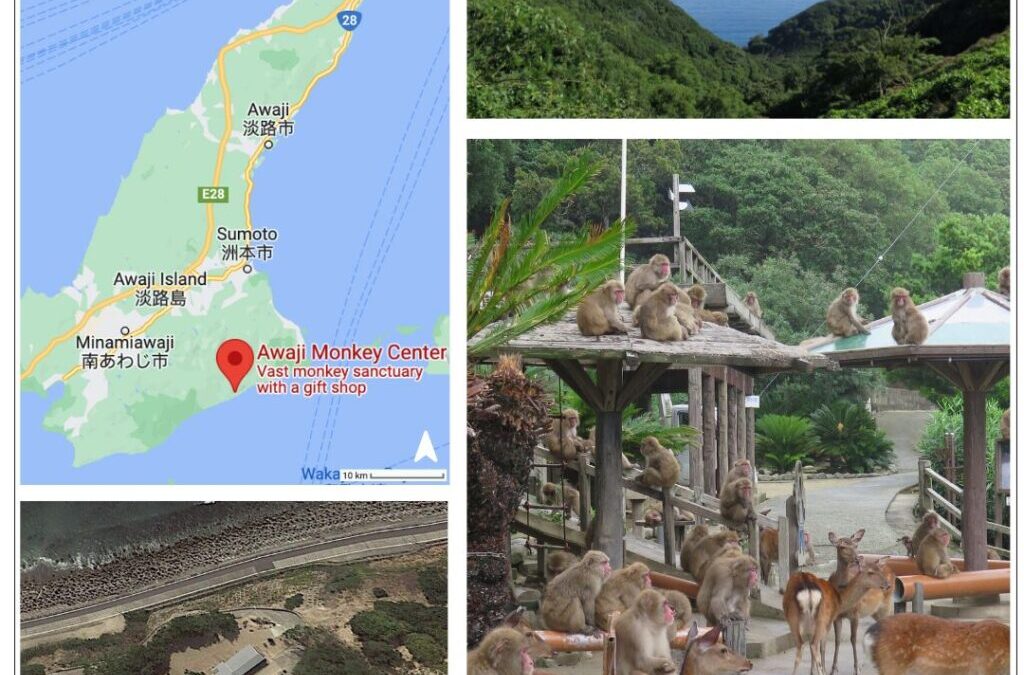
As a PhD student and primatologist in training, I am fortunate I get to observe monkeys and learn about their behaviour. To do this I spend time in places where monkeys are naturally found. The primates I currently study are a large, 400+ group of Japanese macaques (Macaca fuscata). They are wild and free-range in the mountainous forests on Awaji Island, which is located in the Seto Sea of Japan. Here, I am able to visit and observe the group.
Left: (Top) Map of Awaji Island, Japan with the Awajishima Monkey Center identified, (Bottom) An aerial view of the Awajishima Monkey Center, showing the main building and surrounding provisioning fields and forests. Right: (Top) Mountainous topography and view of the Seto Sea, (Bottom) The Monkey Center during a provision feed, Japanese macaques and Sika deer gather to wait for food to be distributed.
Field work requires a lot of planning, as we don’t get to go as often as we would like, nor are we able to stay as long as we would like. Since we have relatively small windows to observe the Japanese macaques, we go in with plans! Really specific and intentional plans.
I carefully plan my studies and methods in advance. This includes discussions with my advisors and both our Canadian and Japanese collaborators. We try to predict potential issues and troubleshoot solutions in advance, all before we even arrive in the field. For this latest field season, I only had about 5 weeks on Awaji Island to gather as much data as I could.
I’ll admit, I love fieldwork. Or, mostly I love fieldwork. Being in the field is a whole different world.
Summers in Japan are hot. Ruthlessly hot. Especially in July and August when we are typically there. Luckily there are excellent shade-providing trees and often ocean breezes that provide a little welcome relief. There are also cooling towels and mini fans that seem like an unnecessary luxury, but are in fact a great investment for those sunny, 45-degree weather days.
I wholeheartedly love observing the monkeys though. I love their vivid (and sometimes soap-opera-esque) social lives. I love seeing who spends time together and how they are mothering their infants. I love how awkward the infants run and play, and how accident-prone they are as they learn and grow.
One of my favourite things is learning to recognize individual monkeys. It is a true skill, especially when there are 400+ monkeys in a group. Our Japanese collaborators know the monkeys so well that they are able to recognize them all by sight. They are also very generous in sharing their knowledge and they help me learn to identify my focal animals.
Identifying individual monkeys! Left: (Top) Manta has a unique large welt on his face (under his eye, by the top of his nose), (Middle) Purico’09 and her son Pukichi grooming, I recognized them from my 2019 field season as Purico’09 has a tall and slender build and her Pukichi was the only infant to be born with two hand malformations that year, (Bottom) Nina, a two-year old female juvenile monkey who was born with absent hands. Right: (Top) Propeller has uniquely shaped ears, they have a little propeller-shaped top part that juts out, (Bottom) Poko is another female monkey who I recognized from 2019, she has a unique face, her brow furrows and her face is also lined with darker wisps of hair.
My PhD research is focused on primate behavioural flexibility. One of the chapters in my final dissertation will be on the variation in decision making in a multi-destination foraging array experiment. To do this, I set up six tables in a Z-shaped array and place food on them to observe how the monkeys move through the array space. I conducted the first phase during my master’s field research.
Images taken during the 2019 field season. Top: (Left) an array table secured to the ground using a bungee cord, (Right) the Z-shaped array set up in a provisioning field. Bottom: (Left) Propeller collects a peanut from the array experiment with an approaching deer, (Right) A juvenile monkey collects a piece of sweet potato from the array using speed to its advantage.
The biggest challenge to collecting my fieldwork this summer was being able to bait the array tables with food. Previously, there were few enough monkeys in my array field that I was able to bait the tables with food before the monkeys would run into the array to collect food. However, this summer there were far more monkeys socializing in the array field, trying to stay cool in the shaded tree-lines, especially in the hot afternoons.
Unsurprisingly, I was unable to successfully collect any array trials the first week I was there. That’s right. Zero data was collected for my foraging array that first week. My advisor and I were coming up with ideas, workarounds really. We settled on trying automated pet feeders.
Automated pet feeders are contraptions that can be programmed to auto-release food for pets at specific times. We settled on a model, we ordered six of them, and waited for them to arrive. When they did arrive, Mr. Nobuhara, one of the monkey center’s owners and inventor extraordinaire, helped us drill holes in the top so we could bungee them to the array tables.
Success! Or so we thought…
All of the above images are examples of monkeys trying to break into the automatic pet feeders we attached to the Z-shaped foraging array tables in the 2024 field season.
I must reiterate, monkeys are smart. They did everything they could to break into those new array feeders. They flipped tables, tried reaching in to take the food, hit the feeders, pressed their buttons, jumped on and kicked the feeders! Luckily, once we acquired (and Mr. Nobuhara installed) 2.5-foot-long metal stakes through the array platforms and into the ground, those things were secure!
The monkeys still tried to break into them occasionally, but once the routine of me baiting the feeders and the food being auto-released later was established, it became much easier to collect data. A fieldwork win for the books!
The final challenge became the weather and keeping the feeders dry! (Apparently feeders covered in water-resistant bags would become curiosities which juvenile monkeys would not be able to resist..)
About the author: Megan Joyce is a PhD student in the Department of Geography, Planning and Environment at Concordia University in Montreal. She is supervised by Dr. Sarah E. Turner and Pierre-Olivier Montiglio. Megan has always loved animals and been interested in their behaviour; her PhD research focuses on primates and their behavioural flexibility.
Par Marianne Turcotte, Étudiante à la maîtrise à l’Université du Québec à Rimouski
C’est vers la fin de mon parcours à la maîtrise en biologie à l’Université du Québec à Rimouski que j’ai eu l’incroyable opportunité de collaborer avec la chercheuse Dre. Sabrina Clavijo-Baquet, basée à l’Université de la République en Uruguay (Udelar). Grâce au prix d’excellence du CSBQ, j’ai eu la chance de rejoindre son équipe de recherche durant les mois d’octobre, novembre et décembre 2024. Aux côtés de Felipe Hourcade, étudiant à la maîtrise à l’Udelar, j’ai contribué à un projet de recherche à la station expérimentale INIA Las Brujas, dans le département de Canelones en Uruguay.
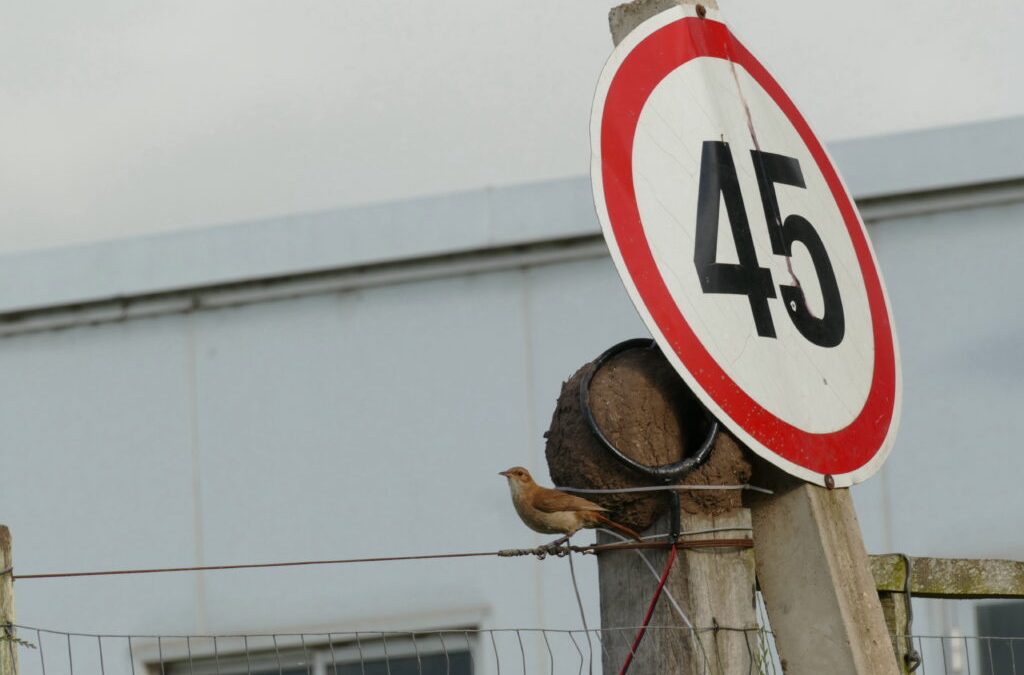
Le fournier roux (Furnarius rufus) près de son nid méticuleusement fabriqué de boue. Une antenne RFID (identification par radiofréquence) a été placée à l’entrée pour suivre les va-et-vient des parents lors de l’approvisionnement.
Ce projet, portant sur la reproduction du fournier roux (Furnarius rufus), combinait écophysiologie et éthologie. Le fournier roux profite des installations anthropiques et des arbres pour accueillir son nid, autant en milieu urbain que rural ou sauvage. Nous avons suivi de près des nids actifs en mesurant plusieurs paramètres, tels que la température interne du nid, le taux de croissance des poussins et leur taux d’approvisionnement par les parents. Nous avons aussi effectué des mesures en laboratoire via un système de respirométrie pour mesurer la conductance maximale et le taux métabolique de base. Nos journées de travail étaient passées en grande partie à l’extérieur, entourés d’une faune et d’une flore impressionnantes. Chaque jour, je mesurais ma chance d’être immergée dans un tel environnement. C’était une première pour moi de voyager à l’extérieur de l’Amérique du Nord en tant que biologiste et ornithologue, et l’Uruguay m’a réellement ébloui. Le nombre d’espèces observées pour la première fois, dont le fournier roux, restera gravé dans ma mémoire.
Le vanneau téro (Vanellus chilensis), l’oiseau national de l’Uruguay.
Mais ce séjour n’a pas été uniquement scientifique. J’ai également eu la chance de découvrir certains des lieux les plus emblématiques de ce pays merveilleux. Mon aventure a commencé par une visite à Colonia del Sacramento, où j’ai exploré le quartier historique, visité des musées fascinants, et même chassé des fossiles sur une plage déserte. Quelques jours avant mon retour au Canada, j’ai visité Punta Ballena, dont la plage de sable fin a marqué la fin de mon séjour sur le terrain. J’ai ensuite exploré Punta del Este et la Barra, deux endroits prisés pour leurs plages et leur ambiance détendue. Le Museo del Mar, l’un des plus beaux musées que j’aie visités, y rassemble des collections impressionnantes d’animaux marins, mais également d’objets historiques, d’insectes et de vieux livres. Pour clore mon voyage, je me suis rendue à Cabo Polonio, un hameau isolé du reste du monde par des dunes de sable, où la colonie de lions de mer, le phare pittoresque, l’ambiance de bout du monde et les baignades matinales resteront parmi mes souvenirs les plus précieux.
Le phare de Cabo Polonio.
Cette expérience m’a ouvert les yeux sur la réalité de la science dans un contexte socioéconomique différent de celui que j’ai connu au Québec durant ma maîtrise. Qui pourrait imaginer toute la polyvalence de la colle chaude et des tie-wraps ?
En somme, l’Uruguay est un pays d’une beauté exceptionnelle, et j’y retournerais sans hésiter, que ce soit pour le travail ou pour explorer davantage ses trésors cachés. Si vous souhaitez découvrir un pays chaleureux où le maté, les asados, la plage et l’hospitalité locale font le charme du quotidien, l’Uruguay est un incontournable.Je tiens à remercier sincèrement le CSBQ pour son soutien financier, le Dr. François Vézina et la Dre. Sabrina Clavijo-Baquet pour cette formidable opportunité, ainsi que Felipe Hourcade pour sa bonne humeur constante malgré les défis du terrain.
À propos de l’auteure : Marianne Turcotte a terminé sa maîtrise en biologie à l’hiver 2025, dans le laboratoire d’écophysiologie aviaire du Dr. François Vézina de l’Université du Québec à Rimouski, codirigée par le Dr.Oliver Love de l’Université de Windsor. Ses recherches portent sur les coûts physiologiques associés aux sites d’hivernage chez le plectrophane des neiges (Plectrophenax nivalis). Sa passion pour l’ornithologie a fait une apparition tardive dans sa vie, lors de l’obtention de son baccalauréat en biologie à l’Université Laval, mais ne la quitte plus depuis.
By Aliénor Stahl, PhD candidate at Concordia University
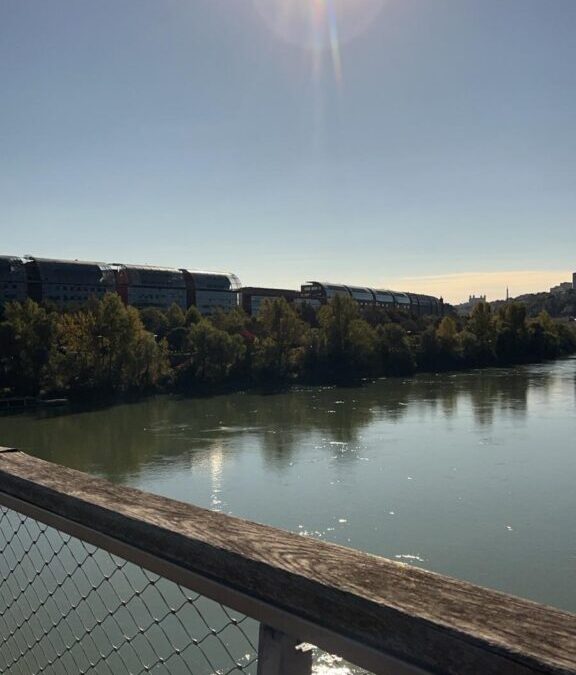
Between October 21 and 25, 2024, I had the incredible opportunity to attend the International Congress in Ecology and Evolution, held by the Société Française d’Ecologie et d’Evolution in Lyon (France), thanks to the support from the QCBS Excellence Award. SFE2 (the French Society of Ecology and Evolution) is dedicated to advancing the sciences of ecology and evolution in France through the development, integration, and sharing of knowledge across all dimensions of these fields. Representing the entire community of French ecologists and evolutionists, SFE2 collaborates with other societies and associations to foster meaningful dialogue among scientists, policymakers, and practitioners, creating a dynamic exchange of knowledge and ideas.
My research focuses on studying and modelling fish abundance with the aim of improving quantitative frameworks for predicting this Essential Biodiversity Variable and guiding decision-making processes in fisheries management. Presenting the first two chapters of my thesis at an international conference provided a meaningful platform for discussing my research with peers, fostering a sense of accomplishment and motivating me as I near the completion of my PhD. Sharing my findings with an engaged audience reinforced the importance of effective communication in research, pushing me to present complex ideas in a way that could be understood by specialists and generalists alike. Preparing my poster involved distilling years of work into a visually engaging and accessible format, which helped me think critically about the core messages of my research. Furthermore, it helped me better understand how to present the key concepts of my work and inspired new ideas for effectively conveying them during my PhD defence.
Moreover, being immersed in an international setting allowed me to observe and learn from the presentation styles of researchers from different cultural and academic backgrounds. I gained insight into how researchers from varied disciplines approach similar scientific challenges, which broadened my perspective on the adaptability of research methods.
Beyond academic engagement, attending the conference helped strengthen my confidence in presenting my work and discussing my findings with new audiences. This experience was pivotal in reinforcing the relevance of my research within the broader field and reaffirming my commitment to advancing my career in academia. As I progress toward completing my PhD, this experience will guide my future academic presentations and collaborations, helping me establish a solid foundation in my field. The encouragement and validation I received from the conference reinforced my commitment to my field of study and provided fresh motivation as I complete my final stages of my thesis.
In addition to the academic enrichment, I was fortunate to have time to explore some of Lyon’s unique attractions. I visited the renowned Parc de la Tête d’Or and spent an afternoon at the Lyon Zoo, where I had the chance to see giraffes up close—a memorable experience amid the lush, scenic park grounds. Later, I ventured into the historic city center to sample Lyon’s famed cuisine at one of its traditional ‘bouchons,’ intimate restaurants that serve hearty, classic Lyonnaise dishes and offer a warm, authentic atmosphere. This culinary experience was a delightful complement to my time in the city, allowing me to appreciate Lyon’s rich cultural heritage while indulging in its unique flavors. Altogether, these experiences made my time in Lyon both professionally rewarding and personally enriching, leaving me with cherished memories of both work and leisure.
About the author:
Aliénor Stahl is a PhD candidate at Concordia University, supervised by Dr. Pedro Peres-Neto and Dr. Eric Pedersen. She is interested in studying fish behavior and studies how to model fish abundance based on species co-occurrence and environmental data, relying on both simulations and empirical data.
Par Catherine Hébert, Étudiante à la maîtrise en sciences biologiques à l’Université de Montréal
J’ai eu la chance de participer à la réunion annuelle conjointe des Sociétés d’entomologie du Québec (SEQ) et du Canada (SEC) qui a eu lieu du 20 au 23 octobre 2024 à l’hôtel Le Concorde de Québec. Des chercheurs et des étudiants provenant de partout au Canada et même de l’international y étaient réunis pour partager leur passion de l’entomologie. J’étais accompagnée de mon superviseur, Colin Favret, ainsi que de la majorité de mes collègues de laboratoire.
L’obtention de la bourse d’excellence du CSBQ m’a permis d’y réaliser une présentation orale des résultats préliminaires de mon projet de maîtrise portant sur la diversité et la taxonomie des Mymaridae présents dans les forêts tempérées du Québec. Les Mymaridae forment une famille de guêpes parasitoïdes qui comptent parmi les plus petits insectes au monde. Ces guêpes parasitent les œufs d’autres insectes et contribuent ainsi à réguler les populations d’insectes qui peuvent être nuisibles. J’utilise le mégabarcoding d’ADN, qui est une méthode permettant de séquencer en parallèle un très grand nombre de spécimens tout en conservant l’identité de chaque séquence obtenue. Mon approche permet également d’accélérer le processus de découverte de la diversité de ce groupe, en délimitant d’abord les espèces à l’aide de leur ADN. Je peux ensuite confirmer ces espèces putatives avec la morphologie, dans une approche de taxonomie intégrative. J’ai reçu de beaux commentaires sur la pertinence de mon projet, ce qui est très encourageant pour la suite. J’ai également pu faire découvrir ces insectes incroyables qui sont malheureusement très peu étudiés.
Figure a. Spécimen de Mymaridae du genre Camptoptera
De nombreuses présentations étaient offertes sur des thèmes variés, comme la lutte biologique intégrée, l’écologie des insectes, la génétique des populations et les pollinisateurs. Il est intéressant de voir les recherches effectuées à travers le Canada. J’ai également eu l’opportunité de faire de belles rencontres, autant d’autres étudiants que de chercheurs établis, lors des deux soirées de réseautage organisées. Nous avons également eu droit à un spectacle de musique haut en couleur, mélangeant plusieurs instruments, des objets insolites et des acrobaties, lors d’un banquet. Ces quatre journées de congrès ont été très enrichissantes et j’en suis repartie stimulée intellectuellement!
Figure b. L’hôtel Le Concorde à l’aubeFigure c. Vue des plaines d’Abraham depuis ma chambre d’hôtel
À propos de l’auteure : Catherine est étudiante à la maîtrise en sciences biologiques à l’Université de Montréal, sous la supervision de Colin Favret. Après un parcours en psychologie, elle a décidé de se réorienter en biologie et c’est durant son baccalauréat qu’elle a découvert sa passion pour l’entomologie. Elle s’intéresse particulièrement à la systématique et à la biodiversité des guêpes parasitoïdes. Elle souhaite faire découvrir l’immense diversité de ces minuscules insectes, ainsi que l’importance de la taxonomie pour toutes les disciplines de la biologie et de l’écologie.
By Rachel Bergeron, PhD student at l’Université de Sherbrooke
Many might have heard the infamous statistic: around 40% of graduate students are depressed. Graduate students are more than 6 times as likely to experience depression and anxiety as are the general population (Evans et al. 2018). The numbers are even greater in women and in transgender and gender non-conforming people, among other visible and invisible minorities.
Why is graduate school, or academia, so destructive for mental health? I am only a few years into a PhD, but here is my attempt at piecing together what have been some of the greatest challenges for my friends, colleagues, and I, with some of the tips and advice I have received that have been helpful.
Research often brings highly variable schedules.
Some weeks are filled mainly with reading and writing at your own pace, others with long hours of field or laboratory work, others with 12-hour days of presentations and networking. Outside of classes and conferences, it is just about entirely up to you to manage your time. This freedom is, in many ways, a huge privilege graduate school offers. It allows the early birds and the night owls both to take advantage of their most productive times of the day, among other obvious advantages. It does, however, come with the challenge of managing and motivating yourself.
The undergraduate experience is punctuated by a series of short-term goals: assignments, midterm exams, final exams. A series of non-negotiable, short-term deadlines. All to be forgotten once handed in. Breaks were provided between semesters, and you could hopefully tackle the next one refreshed. Then we become graduate students, and the multiple, short-term deadlines become one especially long-term one. No more clear assignments, unavoidable deadlines and mandatory breaks, for better or worse.
My personal approach to this one has been to-do lists, and lots of them. Some will find it dizzying, but I keep a master to-do list with the next dozen tasks on my docket, broken up into small manageable bites. Every morning, I select a few to become my objectives for the day. The key to this strategy is to keep tasks small, specific and measurable, and to limit myself to 2 or 3 a day. Small bites mean a few successes every day, and a real feeling of accomplishment by the end of it, hopefully.
Graduate school also comes with far less feedback than undergraduate school did.
Expectations are often unclear, even unspoken, and in many cases, feedback is relatively scarce and only comes in the form of constructive criticism. The absence of comments is to mean a job well done. Recognition is rare. All of this is understandably difficult. Moreover, I feel that many academics tie a lot of their identities to their research, such that it can be especially difficult not to take constructive criticism of their work personally. Not to mention academics are extraordinary critics.
There are as many ways to deal with all of this as there are researchers. I have found that, as intimidating as it can be at first, there is always feedback to be found if you ask for it. Of course, your research director may be the first place to look, but your advisory committee, and even lab mates with a bit more experience than you can be great resources. It is also good to remember that research is what you do, not who you are. Constructive criticism is meant to be just that, constructive. Some are less delicate in their delivery than others, but the objective remains to point you in the right direction, to help you improve on your work. You would not be here if an entire team of researchers far more experienced than you did not believe you have everything it takes.
The office can be wherever you are.
Although, again, there are obvious advantages to this, it has perhaps been my greatest challenge. Given that most of what I do only requires my laptop, there is officially nothing stopping me from working every waking hour, and this field unfortunately tends to encourage it. Publish or perish. More hours could mean more papers, more grants, more lines on your resume. There are limits, however. Proper sleep, a balanced diet, physical activity and rest are all crucial for motivation, concentration, retention, and of course mental health. Recovery from burnout is measured in years.
So, this last piece of advice may be the most important: take breaks. The same way an athlete needs rest to recover, build muscle and prevent injury, we need rest to consolidate knowledge, encourage creativity and replenish our stores of attention and motivation. To sort through all of our mental post-it notes. Your well rested self is capable of accomplishing twice as much in half the time as your exhausted self anyway. For the most productive days, all work-related tasks should be banished from your evenings and weekends, as much as possible. Easy peasy.
I have pinpointed these as my and many of my colleagues’ three greatest challenges as graduate students, but I could go on for a good while. Some honourable mentions include all of the challenges related to living well below the poverty line well into your late twenties, potentially thirties. Financial stress is one of the greatest hurdles of graduate school for many, and the costs of a late start on paying off debt, saving and investing can be felt for decades. Not to mention the damage unhealthy relationships with colleagues and research directors can also cause, particularly ones punctuated by the unbalanced power dynamics still often experienced by women and any and all visible and invisible minorities in academia. That is another topic entirely, one which would deserve its own blog post (at the very least).
Evans, T., Bira, L., Gastelum, J. et al. Evidence for a mental health crisis in graduate education. Nature Biotechnology 36, 282–284 (2018). https://doi.org/10.1038/nbt.4089
About the author: Rachel is a doctoral candidate researching the population dynamics of kangaroos under the supervision of Marco Festa-Bianchet at the Université de Sherbrooke and Dave Forsyth at the New South Wales Department of Primary Industries. She is interested in the interacting roles environmental conditions and population density and structure play in population survival, recruitment, and ultimately growth rate, as well as in the impacts of park visitors and road mortality. She is also a QCBS global representative and vice-president of the UdeS’s Collectif Féminiscience.
What makes this conference special is that the FLARE Network truly sits at the interface between science and policy, and its annual meetings bring together researchers, practitioners and activists under the same roof for an event that is centered on generating (respectful) discussion, new collaborations, and cross-pollination of ideas. As someone who is trying to conduct research in a way that is participatory and cuts across multiple scales and disciplines, I found that my contribution was a good fit for the themes of the conference, and I received a lot of interest and positive feedback after my presentation titled Livelihoods in flux: How forest management for conservation and timber has transformed communities in Mexico.
Andrea Alatorre (second from left) presented in a session titled Forest conservation: commons and contestation.
This year’s theme was “Imagination and Innovation for Forests and Livelihoods”. I therefore thought I would take the opportunity, through this blog post, to highlight some of the most innovative and imaginative frameworks, tools, and approaches that I learned about in this three-day conference.
Since the opening keynote address, it became clear that innovation for forests and livelihoods can take many forms. We heard from Rukka Sombolinggi, Secretary General of the Indigenous Peoples Alliance of the Archipelago (AMAN), who explained the work that her organization does to organize resistance against the governments and corporations that seek to control Indigenous peoples’ ancestral lands and practices in Indonesia. She also had the most potent call for imagining a different world: “Imagine a world where the Pope’s declaration of 1493, which ceded the sovereignty of much of the world’s Indigenous lands to Spain and Portugal, never happened. Where centuries of violence, slavery, and subjugation were replaced by respect and collaboration.” A recording of her complete address is available here.
A lot of innovation seems to be happening in the world of impact evaluation, where a lack of consistent baseline data and the urgency of combating climate change through often competing land-uses has given rise to things like Support Vector Machines (SVMs) methods, as was presented by a panelist from the Food and Agriculture Organization of the United Nations (FAO). Many others presented results from impact evaluations that used imaginative approaches for including demographic trends (like Johan Oldekop, who presented a study on migration and community forests in Nepal), comparing across different land governance regimes in Mexico (Lucas Alencar) and Peru (Pablo Negret Torres), and assessing the impact over time of community forests in Cambodia by normalizing their different start dates (Roberto Toto). And indeed, the closing plenary session included a participation by Sarobidy Rakotonarivo, Research Fellow and Lead at the Mitsilo Research Group, University of Antananarivo (Madagascar), who called for imagining “a culture of impact evaluation” to bridge the funding gap that is required to ensure that forests generate positive effects on forest-dependent peoples.
I was also struck by some of the innovative projects and initiatives that The Tenure Facility is supporting, which were presented in a session titled Innovations and Technology for Forest Governance and Livelihoods: Explore and Imagine with Tenure Facility. These included community-based biodiversity monitoring and video storytelling with a focus on the empowerment of women and youth. At a panel of FAO staff, they also presented the Framework for Ecosystem Restoration Monitoring webpage, which contains a lot of useful data at the global level in an accessible format. And while this is not such a new tool, Alida O’Connor (University of British Columbia) and Malaika Yanou (Chalmers University of Technology) used the Global Person Generated Index (GPGI) in an innovative way by embedding it in semi-structured interviews to assess people’s priorities for landscapes in Ghana and Zambia, and in Brazil, respectively. Finally, I reflect on the fact that sometimes innovation can involve simplifying existing bureaucratic structures. Sujoy Subroto (University of Calgary) explained this for the case of boat permits for communities that live and depend on mangroves in Bangladesh, where the government has imposed a number of processes and requirements that allow brokers to take advantage of villagers through corrupt practices. The distinguished scholar Sharachchandra (Sharad) Lele (Ashoka Trust for Research in Ecology and the Environment) presented a similar situation for the case of India, where communities must develop forest management plans that are needlessly long, complex, and expensive. He presented a pilot project that consisted of co-developing a simplified format with communities, and brought us down to earth by explaining all the reasons why the government does not want to accept this proposal. Innovation, after all, is not enough to drive change.
About the author: Andrea Alatorre is a Mexican biologist and conservation scientist. She is currently pursuing a joint doctoral degree in Ecological Economics and Development Studies at the Université du Québec en Ouaouais (UQO) and the University of Antwerp’s Institute of Development Policy (IOB), respectively. Her research explores the role of incentive-based conservation strategies on the livelihoods of participating communities through mixed-methods and multiscale approaches.