Par Ariane Bouffard, Étudiante au doctorat à l’UQAM
Du 11 au 15 mai 2025, j’ai participé à l’International Conference on Ecology and Transportation (ICOET), qui se tenait à Denver (Colorado, États-Unis). Ce congrès international réunissait près de 650 participants provenant principalement des États-Unis, mais également d’une vingtaine de pays. Ce séjour, rendu possible grâce à la bourse d’excellence du Centre de la science de la biodiversité du Québec (CSBQ), m’a entre autres permis de partager les résultats de mon projet de thèse ainsi que d’échanger avec des scientifiques et acteurs gouvernementaux travaillant dans des disciplines liées au transport et à l’écologie.
Présentation de mes résultats de recherche à l’international
Lors du congrès, j’ai présenté les résultats préliminaires de mon projet de recherche, qui porte sur l’impact de la construction routière sur l’écoulement des eaux souterraines et l’intégrité écologique des tourbières boréales.
Cette étude est menée dans les régions de la Minganie et de la Basse-Côte-Nord, des territoires riches en tourbières. Les données recueillies depuis 2022 révèlent que les routes exercent un effet de barrage qui modifie localement les dynamiques hydrologiques dans les tourbières. Ces modifications demeurent tout de même modestes en comparaison de la variabilité naturelle du niveau d’eau dans ces milieux. D’autres effets des routes plus préoccupants ont toutefois été constatés. Les résultats montrent notamment des changements importants au niveau des paramètres physicochimiques de la tourbe à proximité des routes. Ces modifications ont à leur tour une influence indéniable sur la composition de la végétation des tourbières. Une diminution de la richesse spécifique et une raréfaction des espèces typiques de tourbières, telles que les sphaignes et les lichens, ont d’ailleurs été constatées en bordure des routes. De plus, de nouvelles espèces, non typiques des tourbières de la région, ont fait leur apparition dans ces milieux perturbés.
Ces résultats suggèrent que les effets des routes sur les tourbières s’étendent bien au-delà de leur emprise physique, affectant l’intégrité de l’écosystème sur plusieurs dizaines de mètres de part et d’autre de la route. Ces changements survenant dans les tourbières à la suite de la construction d’une route pourraient d’ailleurs impacter les fonctions écologiques et le potentiel de séquestration du carbone de ces milieux humides.
L’une des diapositives de ma présentation montrant les changements physicochimiques dans la tourbe aux abords des routes ainsi que les causes possibles de ces changements.
Des thématiques au cœur de la conservation de la biodiversité
Le programme du congrès était particulièrement diversifié, abordant des enjeux tels que la mortalité faunique liée aux collisions avec les voitures, l’efficacité des passages fauniques ou encore les impacts cumulatifs des routes et des ponts sur les espèces à statut précaire, dont les chauves-souris. Un grand thème reliait plusieurs des sujets de cette conférence, soit la nécessité de mieux planifier le développement du réseau routier en permettant le maintien ou le rétablissement de la connectivité écologique.
Ce fut également inspirant de constater qu’un grand nombre d’experts partageait mes préoccupations quant à l’effet des routes sur la biodiversité et l’environnement et sur l’importance de réduire leur empreinte écologique. J’ai cependant été étonnée de voir le peu d’études présentées lors de cet événement qui portaient sur les milieux humides. J’étais par ailleurs la seule conférencière à aborder le sujet de l’effet des routes sur les tourbières. Plusieurs participants du congrès ont témoigné de l’intérêt pour mon sujet d’étude tout en m’avouant ne s’être jamais réellement questionnés sur l’impact à grande échelle de l’expansion du réseau routier dans les régions boréales ainsi que dans les tourbières qu’elles contiennent. Cela s’explique probablement par le fait que très peu de tourbières sont présentes aux États-Unis!
Une excursion sur le terrain au cœur des Rocheuses
En marge du congrès, j’ai participé à une excursion d’une journée sur l’Interstate 25, organisée par le Colorado Department of Transportation et le Department of Parks and Wildlife. Cette autoroute traverse un territoire marqué par une transition écologique entre des zones de prairies semi-arides et les montagnes des Rocheuses.
Cette visite m’a permis de voir concrètement les efforts déployés pour intégrer des aménagements visant à favoriser la connectivité écologique et atténuer les impacts environnementaux de ce projet routier. Nous avons visité des passages fauniques, dont un encore en construction, ainsi qu’un secteur où des interventions ont permis de restaurer la plaine inondable d’un cours d’eau traversé par l’autoroute. Cette sortie m’a également permis d’échanger avec les ingénieurs et biologistes impliqués dans la conception et le suivi de ces projets.
Passage faunique sous l’autoroute mis en place pour permettre le passage de la grande faune comme les chevreuils et les wapitis. Le passage intégrait également des abris pour la petite faune (les tas de branches).Passage faunique supérieur en construction. L’autoroute passera dans un tunnel sous le passage qui est aménagé essentiellement pour rétablir la connectivité de l’habitat du pronghorn ou antilope d’Amérique (Antilocapra americana), une espèce endémique de l’Amérique du Nord qui est passée près de l’extinction au début des années 1900.Aménagement en fascine visant à simuler l’effet d’un barrage de castor artificiel pour créer une retenue d’eau et ainsi favoriser une reconnexion du ruisseau avec sa plaine inondable. Les concepteurs de l’ouvrage espéraient que de « vrais » castors viennent éventuellement compléter le travail.
Une expérience formatrice et enrichissante
Participer à l’ICOET a été une expérience enrichissante, tant sur le plan scientifique que professionnel. J’ai pu élargir mon réseau professionnel et échanger avec plusieurs intervenants locaux sur des projets innovants en matière d’écologie routière. J’ai par ailleurs pu constater à quel point une approche interdisciplinaire et une collaboration entre les concepteurs de routes et la communauté scientifique permettent la conception de routes plus vertes. Cela m’a aussi permis de contextualiser mes résultats relativement à ce qui est actuellement étudié dans le domaine de l’écologie routière.
Finalement, je tiens à remercier le CSBQ pour son soutien financier, sans lequel cette expérience n’aurait pas été possible.
À propos de l’auteure:
Ariane Bouffard est candidate au doctorat à l’Université du Québec à Montréal (UQÀM). Elle étudie en Sciences de l’environnement, sous la direction de Marie Larocque (UQÀM) et Monique Poulin (Université Laval). Son projet d’étude est réalisé en partenariat avec le ministère des Transports et de la Mobilité durable ainsi que dans le cadre de la chaire de recherche sur l’eau et la conservation du territoire. Les intérêts de recherche d’Ariane portent sur l’écologie routière, les milieux humides et la biodiversité. Ariane travaille également comme biologiste au ministère des Transports et de la Mobilité durable où elle exerce un rôle de conseillère et de spécialiste en environnement dans le cadre de projets routiers d’envergure.
By Paige Smallman, PhD student at McGill University
I spent years learning to breathe underwater with tanks and regulators, only to discover that holding my breath might be the key to conducting my thesis research.
From SCUBA to Freediving
I started SCUBA diving in 2019. At the time, I was an undergraduate oceanography student at UBC. My open water certification opened up the underwater world to me, and seeing everything I was learning about in class underwater was addictive. I went diving most weekends and levelled up slowly with more certifications and gear. After I graduated, I started working at the Vancouver Aquarium, where I became a certified scientific diver.
SCUBA diving is an inherently risky activity; humans are just not made to be underwater. However, through extensive training, trust in my dive buddy, and years of practice, I find that I’m at my most relaxed underwater.
Freediving, however, was entirely outside my comfort zone. When you freedive, you rely 100% on your own ability to hold your breath and swim, with just a mask, fins, and a weight belt. Despite my initial reluctance, the practical advantages are compelling. Freediving involves significantly less logistical complexity than SCUBA operations. The reduced gear requirements make it particularly attractive for research projects with limited budgets, and the ability to move quickly between shallow sampling sites increases field efficiency.
As a second-year PhD student, I’m working on a project in Panama studying biodiversity in coral reefs using environmental DNA (eDNA). This technique captures genetic material that all organisms constantly shed into their environment through skin cells, scales, mucus, and waste. When we visit a coral reef, we collect bags of water and tubes of sand that contain this invisible genetic signature. Back in the lab, we extract and sequence all the DNA to reveal a comprehensive list of fish and other organisms that were recently in the area. This approach allows us to detect cryptic and rare species that traditional visual surveys often miss, providing an unprecedented window into coral reef biodiversity without disturbing the ecosystem.
With my first field season in Panama rapidly approaching and the paperwork for SCUBA still pending approval, I realized I would likely have to set aside the SCUBA gear and freedive to collect my samples. My supervisor assured me, “It will be easy! The reefs are shallow! No more than 5 metres deep!” But I wasn’t so sure, and I realized I needed some formal training.
Training and Certification
With funding from QCBS, I signed up for a freediving course at ApneaCity in Montreal for the AIDA 2 certification (Association Internationale pour le Développement de l’Apnée). The course included classroom sessions to learn about the human physiology of freediving, the theory behind the equipment, safety practices, diving techniques, and even competition rules. We took our new theoretical knowledge to the pool, where we practiced static breathholds, swimming while breathholding, and rescue. I gained some confidence and completed my 2-minute static breathhold and 40-metre dynamic dive, completing the first half of my certification training. Armed with my pool certification and newfound confidence, I was ready to put theory into practice.
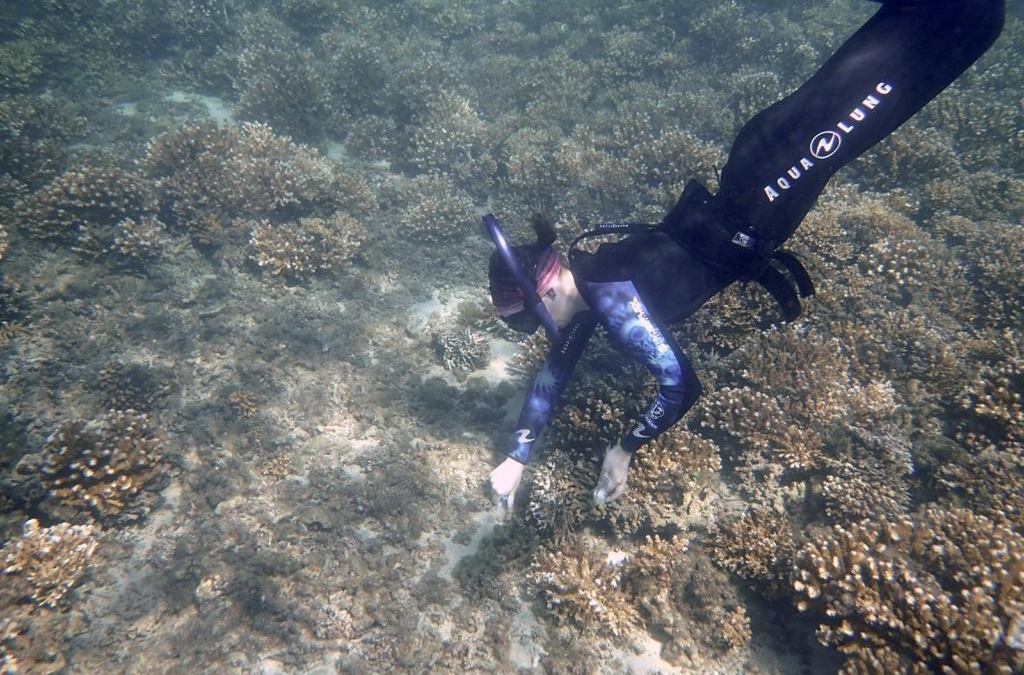
Freediving to collect sediment samples for eDNA in Coiba National Park, Panama
Testing Skills in the Field
When I arrived in Panama, I successfully collected all 80 tubes of sand and 40 bags of water using my new freediving skills. While most of the sites were calm and shallow, some sites put my training to the test. On the last day in the Las Perlas Islands, we arrived at our final site for sampling. The current was strong, the waves bigger than they had been all week, and the sediment I had to collect was at least 10 metres down. I quickly realized that I had to swim hard just to stay in one place at the surface. The AIDA training taught me the importance of mindfulness and relaxation in freediving, so I held on to the anchorline to keep myself stable while I caught my breath. I closed my eyes, relaxed my whole body, breathed deeply, and dove down. I made it to the bottom, filled my sample tubes, got back to the surface, and repeated the process until I had all my samples.
Back in Montreal in the spring, I completed the depth training for the AIDA 2 certification. In the cold, clear waters of the Kahnawake Quarry, I made it to 17 metres deep with one breath of air!
A beautiful spring day at Kahnawake Quarry, where I learned how to freedive.
Lessons Learned
Stepping outside my comfort zone and into the deep on a single breath, I learned that adapting our methods can open new doors for discovery and personal growth.
Although I’m not planning to start freediving competitively, I will continue training to get more comfortable being underwater on one breath. I highly recommend that anyone doing aquatic fieldwork complete AIDA training. The process made me even more aware of how difficult freediving is and how important proper training is to stay safe. I’m very grateful to QCBS for supporting this training. I’d also like to thank my lab mates, Tess Morelli, Saúl Fernando Rodríguez, Helio Quintero, Maria Chacón, Isabela Buxbaum, Yaliana Chichaco, and Jorge Reque for helping me collect my samples.
About the Author:
Paige is a PhD student in the Barrett Lab at McGill University and the Leray Lab at the Smithsonian Tropical Research Institute. Her research is focused on marine biodiversity using environmental DNA and fish genomics. Paige loves diving, whether in warm tropical seas or icy Canadian waters.
Par Marianne Allard, Étudiante à la maîtrise à l’Université de Montréal
La plongée, c’est un monde en soi. C’est l’accès à un monde tellement différent de celui dans lequel on vit.
Ayant toujours eu une passion pour le monde marin, cela faisait longtemps que je voulais apprendre à plonger. C’est finalement en 2023 que j’ai décidé de prendre les cours pour avoir ma certification. J’embarquais dans cette aventure complètement seule, mais j’ai fait beaucoup de rencontres sur mon chemin. J’ai commencé mon parcours à la maison, au Québec. J’ai commencé par les cours en piscine, pour ensuite faire la certification en eau libre dans la carrière Flintkote à Thetford Mines.
Ayant maintenant en main ma certification de plongée Open Water Diver (le premier niveau de plongée), j’avais un plus grand projet en tête. Je voulais continuer ma formation en Indonésie ! Mon but était de m’améliorer et apprendre de nouvelles techniques de plongée, et ce, dans un contexte de plongée scientifique. J’ai donc appliqué sur le programme qui m’intéressait, et en quelques semaines j’avais la confirmation, j’étais prise ! En quelques mois, tout était mis en place; les billets d’avion étaient achetés et je m’étais procuré de l’équipement de plongée supplémentaire. Pendant l’hiver, j’ai fait un cours de plongée en piscine deux fois par mois pour ne pas tout oublier. Il ne restait plus qu’à attendre que le mois de mai arrive pour que je puisse finir mon baccalauréat et enfin partir !
L’attente était interminable, mais le grand jour approchait de plus en plus. Examen après examen, la fin de la session approchait. Mon baccalauréat tirait à sa fin. Finalement, quelques semaines plus tard, j’étais enfin en route vers l’aéroport. Après plus de 30 heures de déplacement, j’étais à Bali, où j’allais passer la nuit. Le lendemain, j’avais encore 2h30 de voiture à faire et 3 heures de traversier. Après tout ce temps, j’étais enfin rendue à Gili Air, une petite île de quelques kilomètres près de Lombok, où j’allais passer les 6 prochaines semaines à plonger. Avec le décalage horaire, mes premiers jours sur l’île ont servi surtout à me reposer et trouver mes repères dans ce nouvel environnement.
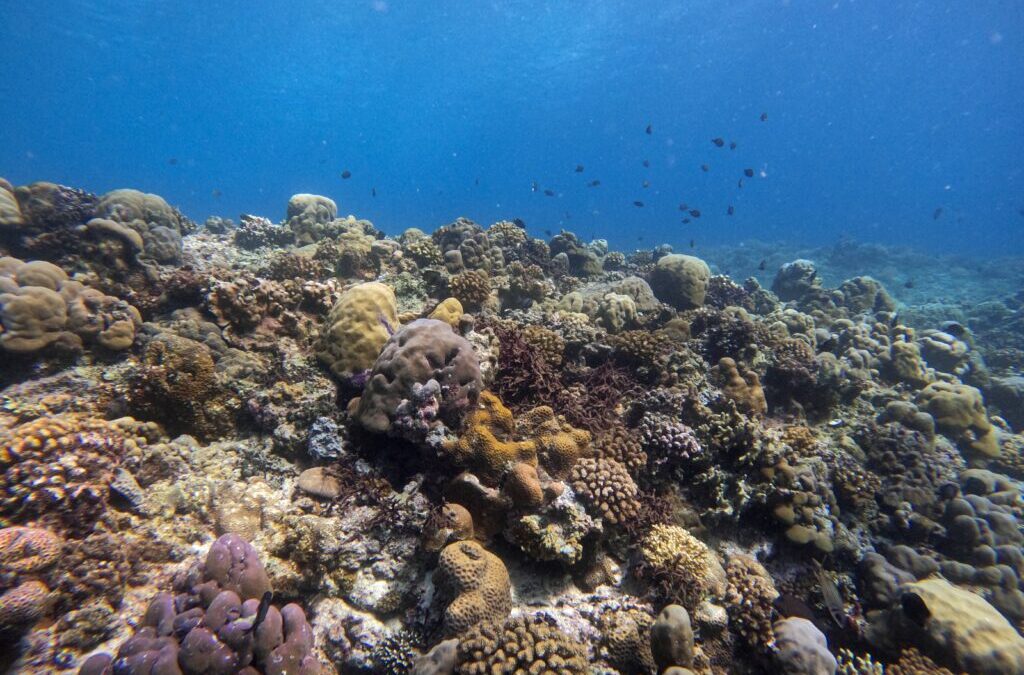
Récif corallien naturel en bonne condition, malheureusement de plus en plus rare dans la région et dans le monde
J’ai commencé le programme en complétant mon niveau de plongée suivant, le Advanced Open Water (le niveau 2). Par chance, je suis tombée sur une instructrice française et j’ai eu un cours privé, donc j’ai fait le cours en français ! Deux jours et cinq plongées plus tard, j’obtenais ma certification.
La première plongée était très spéciale. Je découvrais toute la vie marine d’un coup ! Mes premiers coraux, mes premiers poissons, ma première tortue et mon premier requin! Un monde venait de s’ouvrir à moi. Un monde que je sais que je ne vais jamais quitter.Durant les semaines suivantes, j’ai fait le cours de plongée scientifique de PADI, en plus d’un cours beaucoup plus poussé avec Conservation Diver. J’ai appris beaucoup de techniques que j’ai pu mettre en application durant mon séjour. Au rythme de 2 plongées par jour, 4 fois par semaine, je me suis rapidement accumulé presque 50 plongées durant mon temps à Gili Air.
Réalisation d’un transect dans le cadre du cours EMP (environmental monitoring program) de Conservation Diver
J’ai appris beaucoup sur la réalité locale aussi. J’ai vu pour la première fois des récifs de corail, mais je voyais aussi les dégâts des humains sur ces récifs. Autour des Îles Gili, la pêche aux explosifs et au cyanure, maintenant illégale, a longtemps été pratiquée et a laissé des traces. La pêche aux requins est encore grandement pratiquée en Indonésie. Aujourd’hui, une aire marine protégée englobe les eaux autour des 3 îles Gili (Gili Air, Gili Meno et Gili Trawangan). Malgré les efforts de conservation actuels, il ne reste que 10% du couvert de corail que l’on pouvait observer autrefois. Le réchauffement de nos océans menace les coraux partout à travers le monde, mais la région des Îles Gili est particulièrement vulnérable en raison de sa topographie.
C’est pourquoi j’ai trouvé particulièrement valorisant d’apprendre et appliquer des techniques de restauration de récifs. Chaque semaine, deux plongées étaient dédiées à installer et entretenir les structures de restauration, ainsi que d’ajouter des nouveaux fragments de coraux.
Structures de restauration de coraux installées dans le cadre d’une collaboration artistique avec un artiste britannique
À travers cette expérience, j’ai beaucoup appris sur la plongée scientifique et les îles Gili, mais aussi sur moi-même et sur ma passion grandissante pour la biologie marine. Ça m’a aussi permis de confirmer que je veux absolument travailler en biologie marine et passer ma vie dans l’eau salée!
Ce programme m’a donné une belle expérience pour mon CV, et m’a beaucoup aidé pour l’obtention de mon projet de maîtrise pour travailler sur les coraux mous dans les Caraïbes.
Dans le cadre d’un cours de maîtrise sur la biodiversité, j’ai complété la page Wikipédia en français sur les Îles Gili. Voici le lien si vous voulez en apprendre plus sur le sujet : https://fr.wikipedia.org/wiki/Îles_Gili.
À la fin de mon séjour à Gili Air, j’avais non seulement atteint mon objectif d’améliorer mes techniques de plongée et d’acquérir des nouvelles habilités, mais j’avais aussi rencontré beaucoup de passionnés de l’océan. Et comme c’est un programme qui est ouvert à tous, j’ai maintenant des amis un peu partout à travers le monde!
À propos de l’auteure:
Marianne Allard est étudiante à la maîtrise en sciences biologiques à l’Université de Montréal dans le laboratoire de Christopher Cameron. Elle travaille sur les vibrations induites par vortex (VIVs) sur les coraux mous des Caraïbes. Les VIVs sont un type de phénomène vibratoire largement observé et étudié sur les structures humaines mais encore très peu étudié sur les êtres vivants, encore moins sur les animaux.
Par Alexandre Demers-Potvin, Titulaire d’un doctorat de l’Université McGill
Imaginez que vous êtes dans une forêt subtropicale marécageuse. Un petit alligator avec des dents rondes prend un bain de soleil à vos pieds. Tout à coup, il glisse dans l’eau à l’approche d’un gros ongulé qui ressemble vaguement à un tapir. La nuit, vous reconnaissez un cousin éloigné du galéopithèque moderne, un petit mammifère qui plane d’arbre en arbre à l’aide de replis de peau qui s’étendent entre ses membres. Si vous restiez dans cette forêt pendant plusieurs mois, vous réaliseriez que vous voyez le soleil de minuit durant l’été et que vous êtes dans la noirceur quasi totale durant l’hiver. Mais où êtes-vous donc si cette forêt luxuriante persiste sous un régime solaire digne des régions polaires actuelles? Comment est-ce possible?? Bienvenue au Nunavut, tout près du pôle Nord… il y a 50 millions d’années. Gastornis, un oiseau géant de plus de 2 mètres de haut qui ne vole pas, nous rappelle que les dinosaures dominaient autrefois ces terres, alors que les mammifères se diversifient désormais à un rythme sans précédent. Par exemple, cette forêt contient des carnivores aquatiques semblables à des loutres (mais qui en sont évolutivement très distants) et même un cousin éloigné du pangolin. Cependant, à quel point cette communauté est-elle plus ou moins diverse que celles des latitudes inférieures? Voici une des questions que mon équipe tente de résoudre.
L’objectif de mon équipe est de reconstituer le réseau trophique d’une faune de vertébrés fossiles provenant de Bay Fjord, au beau milieu de l’île d’Ellesmere. Plusieurs de ces espèces ont été décrites ou sont en cours de description, mais personne à ce jour n’avait tenté de reconstituer les chaînes alimentaires de cette communauté à très haute latitude en combinant toute l’information disponible à partir de ses fossiles… avant nous. Ce projet est important pour le monde actuel, car il vise à comprendre la structure d’une paléocommunauté terrestre à une époque où le gradient climatique latitudinal était bien moins prononcé qu’aujourd’hui, mais où les mêmes contrastes de photopériode persistaient. Comment ce régime de luminosité extrême affectait-il la productivité primaire de cette forêt par rapport à des localités à plus basse latitude? Est-ce que ça explique, par exemple, pourquoi cette forêt grouille de tapirs, mais ne semble contenir aucun cheval primitif, alors que ces derniers étaient déjà des herbivores dominants ailleurs? Alors que l’Arctique se réchauffe présentement à un rythme supérieur au reste de notre planète, ce projet pourrait mener à des hypothèses sur la structure des communautés de cette région dans un futur lointain, en examinant une communauté éteinte provenant d’une période plus chaude de l’histoire de la Terre.
Ici je tiens une minuscule mâchoire inférieure, l’holotype (et seul spécimen connu) d’un mammifère placentaire énigmatique nommé Arcticanodon dawsonae. Cette espèce, décrite en 2004, a été associée à Palaeanodonta, un clade complètement éteint de mammifères qui est probablement le groupe sœur des pangolins, même si l’espèce paraît bien différente des pangolins actuels de par sa petite taille. Ce spécimen appartient au territoire du Nunavut.
Nous avons donc examiné, photographié et mesuré quelques douzaines de spécimens de dents et de mâchoires afin de déterminer les relations prédateurs-proies plausibles dans cette communauté disparue et pour estimer la masse corporelle de chacune de ces espèces. C’est important d’estimer la masse quand on le peut, car ce trait morphologique s’avère être très prédictif des liens trophiques entre espèces, particulièrement chez les mammifères. Afin d’acquérir ces données, mes collègues et moi avons passé une semaine dans les collections du Musée canadien de la nature à Gatineau, où se trouvent aujourd’hui ces spécimens. Il faut également noter que les fossiles collectés après la fondation du Nunavut en 1999 appartiennent aux Collections Patrimoniales de ce territoire. Par contre, ils sont conservés au Musée canadien de la nature, car il manque un bâtiment adéquat pour les préserver au Nunavut. Cela signifie toutefois que nous avons dû obtenir une permission distincte de la part du gouvernement du Nunavut pour accéder aux spécimens collectés plus récemment.
Voici un fragment de la mâchoire inférieure d’un des animaux les plus proches des humains connus à ce jour de l’Éocène d’Ellesmere. Il s’agit d’un primate primitif faisant partie du groupe désormais éteint des Plesiadapiformes. Même si ses molaires ressemblent vaguement aux nôtres, des squelettes plus complets nous révèlent que ces primates ressemblaient plus à des écureuils qu’aux primates primitifs actuels tels les lémuriens! Ce spécimen appartient aussi au territoire du Nunavut.
J’ai obtenu le financement du CSBQ pour ce séjour, mais c’est Louis-Philippe Bateman qui est le chercheur principal de ce projet dans le cadre d’une maîtrise qu’il a commencé sous la supervision du professeur Hans Larsson cet automne. Comme je venais juste de défendre ma thèse de doctorat dans ce même laboratoire, j’ai offert à Louis-Philippe de l’assister dans sa collecte de données pour une semaine. Notre équipe était complétée par Gabrielle Bonin, une ancienne étudiante en biologie à McGill, qui a aussi obtenu une maîtrise en paléontologie à l’Université d’Édimbourg. Qui plus est, le mémoire de Gabrielle portait sur l’estimation de la masse corporelle de mammifères éteints en mesurant leurs dents, une méthode d’une importance capitale pour le projet que l’on a commencé considérant l’état très fragmentaire des mammifères de l’Éocène d’Ellesmere (voir les figures 1 et 2 en exemple). Cette faune est loin d’être la mieux préservée de cette époque, mais elle demeure précieuse, car c’est presque une des seules à nous offrir un aperçu du monde durant une période « à effet de serre » de l’histoire de notre planète près du pôle Nord, avec les impacts qu’une photopériode extrême peut avoir sur la biodiversité.
À propos de l’auteur
Alexandre Demers-Potvin vient de défendre sa thèse de doctorat en biologie à l’Université McGill dans le laboratoire du Prof. Hans Larsson. La curiosité qu’il portait pour la préhistoire dès son plus jeune âge l’a mené aujourd’hui à la recherche de dinosaures et d’autres créatures disparues sur quatre continents, des badlands de l’Alberta aux sables du Sahara au Niger, en passant par les Andes de la Colombie et l’ancienne carrière de pétrole de schiste de Messel en Allemagne. Pour sa thèse, il a retracé les changements dans la structure de la communauté qui évolua dans le Parc provincial Dinosaur en Alberta il y a environ 76 à 74 millions d’années, vers la fin de l’ère des dinosaures.
In December 2024, I defended my Ph.D in ecology. I know this is not something people often say, but I genuinely loved how my thesis turned out, and I loved my defense even more. I was on fire. I left that room feeling proud, energized, ready for the next chapter.
Four months later, I was in a hospital bed, unable to move from the pain searing through my entire body, being told I have terminal lung cancer.
This post is not about the long journey from pain to treatment, to less pain, to walking again, to reclaiming pieces of a “normal” life while I wait for the worst. It is about something else… Something quieter, but just as profound: how losing the privilege of thinking in terms of decades changed the way I live, and more specifically, the way I do science.
Now, everything in my life, including my role as a research scientist, is filtered through a new kind of clarity. A paper rejection? Not that big of a deal. Giving a talk? No longer terrifying. Saying no to exhausting networking events that drain rather than energize me? Surprisingly easy.
I understand now, more than ever, that if work is going to be part of the rest of my life, then it has to be something I truly love. For me, that is coming into the lab with a burning question and getting lost in conversations with colleagues as we chase down answers. It is spending hours translating theory into code and back again. It is writing and rewriting a single paragraph until it finally says what I need it to say, and then rereading it the next morning and realizing it is total garbage 🙂 It is collaborating with people I love. It’s teaching what I know and learning what I do not. It is doing science not just for the sake of doing it, but to leave something behind. A trace. A memory. A legacy.
Research is no longer a stepping stone to that dream position I used to picture. For me, now, research is the dream. It is not the means… it is the end.
About the author: Though the author has chosen to remain anonymous, they share this story as a gentle reminder that being alive and well is a privilege and we should never take it for granted. May it nudge the readers to seek what gives their days meaning and to find the quiet joy in doing what truly matters, not only in academia, but in every corner of life. And if you or someone you love is going through something similar, please know that you are not alone. As long as we are breathing and our hearts keep beating, there is hope
By Camille Lévesque, PhD Student at Université Laval
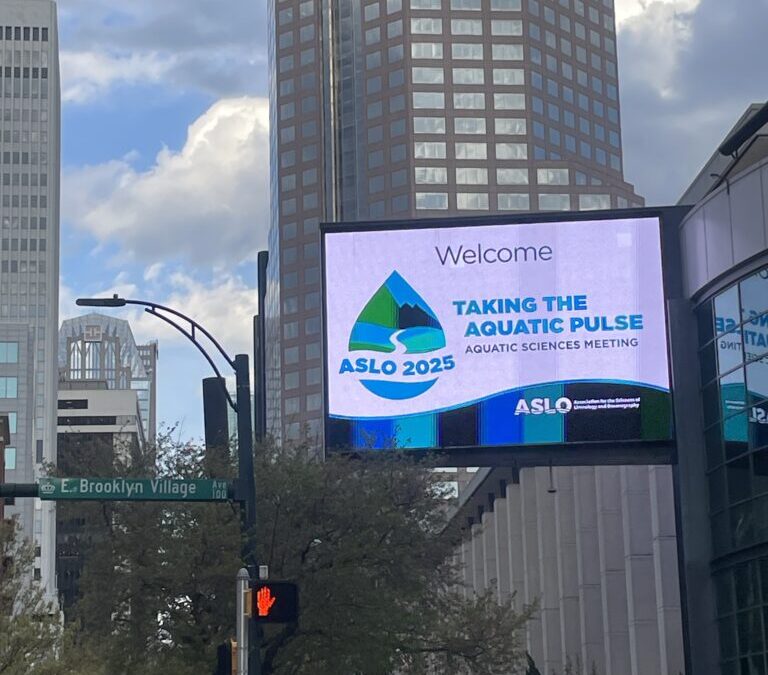
This March, I attended my first international conference! I travelled to North Carolina for the Association for the Sciences of Limnology and Oceanography’s (ASLO’s) Aquatic Sciences Meeting. It was an enriching experience that enhanced my academic knowledge and professional development. The conference offered a variety of talks displaying the diverse research being conducted in limnology and oceanography.
The theme of the conference, “Taking the Pulse of Aquatic Ecosystems,” was particularly relevant given the threats posed by climate change and increasing human impacts to water systems. With over a thousand attendees, the topics at the meeting ranged from localized studies, such as the paleolimnological history of specific lakes, to large-scale efforts, like global mapping of sea ice. I appreciated learning about these different scales of research and stepped outside my “scientific comfort zone” to engage with fields I was not very familiar with, such as the biogeochemistry of Arctic lakes and the use of ponds for flood management in North Carolina.
While the conference allowed me to meet participants from various countries, I also enjoyed connecting with other professionals from Quebec who work in similar fields. I found it rewarding to establish these connections, knowing that I would likely encounter them again at local conferences or in future scientific events. Networking is important in our field, and I left the conference with a sense of community and support.
The conference coincided with the beautiful spring bloom of the flowering trees in Charlotte, which made the city picturesque and fragrant. I took time to explore the area, discovering local parks and trying out several restaurants.
A major highlight of the conference was presenting my research findings through a scientific poster. This opportunity allowed me to communicate my project to a wider audience and engage in discussions with fellow aquatic scientists. These conversations provided meaningful feedback that will help improve my work. As I approach the end of my master’s program, this experience was an excellent way to conclude my project and share my findings with the scientific community. I especially enjoyed engaging with researchers who also focused on reservoir ecosystems, as our shared interests led to valuable insights and enriching conversations.
In summary, the ASLO meeting in Charlotte was an impactful experience that combined scientific learning, networking, and personal enjoyment. It broadened my understanding of aquatic systems, helped me establish professional relationships, and left me feeling inspired as I continue my academic journey in aquatic science. It was amazing to witness the unwavering commitment of scientists to understanding the impacts of climate change and monitoring the health of aquatic ecosystems, despite the challenges facing the world today. I am eager to apply the insights I gained and continue learning more about the fields of limnology and oceanography.
About the author:
Camille Lévesque is a Ph.D. student at Université Laval, under the supervision of Dr. Caroline Bouchard and the co-supervision of Dr. Olivier Morissette from Université du Québec à Chicoutimi (UQAC). She recently completed her M.Sc. at Université de Sherbrooke under the supervision of Dr. Dominique Gravel and the co-supervision of Dr. Katrine Turgeon from UQO. Passionate about nature and wildlife from a young age, Camille developed a specific interest in fish during her undergraduate studies. In her free time, she enjoys hiking and gardening. Her research interests include computational ecology and fish ecology. LinkedIn: https://www.linkedin.com/in/camille-l%C3%A9vesque-67ab2a1b8/