By Marie Sophie Roy, Master’s student at Concordia University
Reindeer (Rangifer tarandus) are usually considered quiet animals. With their calm and watchful gaze, they often appear contemplative and reserved. Yet if you listen closely, a soft, distinct clicking sound accompanies their steps, barely audible beneath the whisper of the wind. But when mating season arrives, the silence breaks.
High-ranking male reindeer become markedly more vocal, emitting low, guttural sounds believed to attract females and signal social status. This increased acoustic signaling during the mating season allows us to investigate whether male reindeer exhibit flexible vocalizations depending on the nearby individuals. This modulation of vocal behavior based on the audience is known as the “audience effect.” The main objective of our fieldwork, carried out in fall 2024, was to explore this potential audience effect in male reindeer vocalizations. To achieve this, we had to 1) find the reindeer and 2) record their vocalizations.
Finding the reindeer
Given that animals of this size cannot be kept in laboratories, fieldwork was necessary to study reindeer. Fortunately, we had access to a semi-domesticated population of reindeer at the Kutuharju Reindeer Research Station in Kaamanen, Finland. These reindeer roam freely within spacious enclosures (~15 km²), offering a unique opportunity to observe their behavior in a natural setting.
Kutuharju Field Research Station, located in northern Finland.
Because the reindeer move freely across such a broad area, it is useful to have a tool to track them. In the past, telemetry was employed by fitting high-ranking males with VHF radio collars. Trackers using an antenna and receiver could pinpoint the direction the reindeer were moving. When close enough to receive a signal, a reading could be taken at any time.
This field season, however, we switched to real-time GPS collars linked to the Ranniot application, a positioning and navigation service design for tracking. The decision was made together with our Finnish collaborators, as local herders had recently adopted Ranniot, primarily because the collars are lighter and better support the welfare of the reindeer. Learning to use this new system came with a few challenges. Although our Finnish collaborators helped introduce the app on the first day, the app interface was only available in Finnish, a language completely foreign to those of us in the field collecting data. To make matters worse, it wasn’t fully compatible with iOS, leaving us with just one functional device for tracking. It also took us a few days to figure out the optimal time interval between position readings, which refers to how often a GPS position was recorded. The shorter the interval, the quicker we could find the reindeer, but that also meant burning through the battery faster.
Tracking reindeer in the field
On the first day, we spent hours reaching the last recorded position, only to find that the reindeer had already left. Unlike telemetry, where you can actively take readings when needed, the GPS system felt much more passive. You are essentially left waiting for the next reading, and that lack of control can be frustrating. So, there we were, standing around, waiting for the next update… and then sprinting off again to the next location! That said, once we figured out that a 15-minute time interval between readings worked best, the system turned into a useful tool. Being able to see our own position on the map helped us avoid tricky terrain like bogs or steep hills, letting us plan a more efficient route.
Recording the vocalization
Once the reindeer were located, the next essential requirement was having a reliable device to record their vocalizations. We brought along a Zoom H6 recorder paired with a shotgun microphone attachment. It was simple to use and easy to carry, which was important since we often had to move quickly and adjust our position to follow the animals.
To record male vocalizations, we also needed to be present during the mating season, known as the rut. While it typically occurs around October, its exact timing can vary from year to year. The local herders helped us choose the best time to be there to catch the rut at its peak.
A reindeer mating group, with the high-ranking male in the foreground, remaining vigilant to deter competing males.
After that, it was only a waiting game. We positioned ourselves on the outskirts of the mating group, staying close enough to capture good-quality audio without disturbing them. It required us to minimize movement and noise, while still being ready to follow the reindeer as they moved around. Most importantly, we had to endure the cold, hoping we wouldn’t freeze while waiting for the male to finally vocalize.
Recording reindeer vocalizations from the edge of the group using a portable audio recorder. (Photo by Robert Weladji)
Despite these few challenges, the data collection went smoothly. We ended up staying for two weeks, during which we successfully collected numerous male vocalizations. It was an unforgettable experience, and I’m genuinely excited to see what insights this data will reveal!
About the author: Marie Sophie Roy is a Master’s student in the Weladji Lab at Concordia University. Her interest in animal ecology led her to study the impact of female reproductive status in reindeer mating behavior.
By Brogan Stewart, PhD Candidate at Concordia University
Graduate school often overlaps with the time in life when many women begin thinking about or experiencing pregnancy. Yet, I find it is a topic that is surprisingly underdiscussed in academic spaces. When my fiancé, Jeremy, and I decided we were ready to have a child, I was still pursuing my PhD at Concordia University in Montreal. We carefully planned the timing of the pregnancy so that I would be finished with the fieldwork component of my research. That way I would be available for the onslaught of doctor’s appointments that are typical with pregnancy. I also scheduled those appointments with the academic calendar in mind, particularly around the conferences I hoped to attend that year.
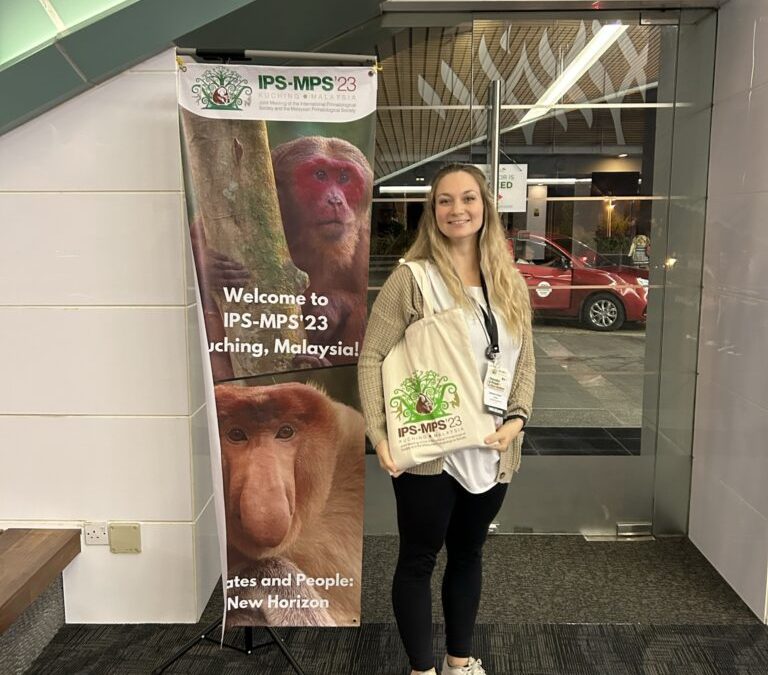
Pregnancy shifts your perspective – suddenly, it’s not just about you anymore. At the same time, you are trying not to lose the parts of yourself that bring you joy and purpose. For me, that meant finding a way to attend an international conference, something I genuinely enjoy, while also prioritizing comfort for both me and my growing son. I comfortably (for the most part) attended the International Primatological Society (IPS) conference in Malaysian Borneo in August 2023 while I was five to six months pregnant. I would like to share some insights, advice and key takeaways from my experience.
Before I get into the specifics, I would like to sincerely thank the Quebec Centre for Biodiversity Science (QCBS) for supporting my attendance at this conference. Their assistance allowed me to present my work, meet inspiring researchers with similar interests, and gain valuable insights that have helped shape the next steps of my academic journey. I appreciate their support in helping young researchers grow, but also in empowering me as I navigate this new chapter as a mother.
Quick disclaimer, the content of this post reflects my personal experiences and what worked for me regarding conference travel during pregnancy. Everyone’s pregnancy journey is unique, and what felt right or manageable for me may not be appropriate for another. While I’m happy to share tips and insights, please remember that this is not medical advice. If you are pregnant and considering travel, always check in with your healthcare provider and prioritize their guidance over any suggestions offered here.
Before booking a flight for that international conference, I would recommend first gaining a sense of how your pregnancy will be. I was one of the extremely fortunate people to experience minimal discomfort during my pregnancy – aside from fatigue during my first trimester and being uncomfortable at the end of my third trimester, I felt remarkably well. In fact, I loved being pregnant and found it to be an enjoyable and positive experience. However, that is not the case for everyone. For instance, one of my best friends, Brittany, experienced severe and persistent nausea throughout all trimesters of her pregnancy and required medication to manage it. Prior to witnessing her experience, I had not realized such a level of discomfort was even possible. Had I been in her situation, I doubt I would have felt comfortable leaving my home, let alone the country. There was a conference I had initially considered attending during my first trimester, but I ultimately chose to participate online. I did not want to take the financial risk of travelling only to potentially spend the entire time sick and confined to a bathroom.
I intentionally scheduled my international conference trip to take place during my second trimester, often referred to as the “honeymoon trimester.” In the end, I am very happy that I made this decision. Although I continued to feel well into my third trimester, the physical changes during that stage—particularly increased size and difficulty finding comfortable positions—can make travel more challenging. These discomforts are not ideal when sitting for extended periods, whether in folding chairs at a conference or on long flights. Additionally, it is important to note that some airlines have restrictions for allowing passengers in their third trimester to board, as a precaution against the possibility of going into labor during the flight. Something worth considering during the planning process!
When booking a hotel or private rental accommodation, I recommend allowing for an additional day or two both before and after the conference for rest and recovery. While traveling to Borneo, I encountered a health issue that required medical attention (unrelated to the pregnancy). As a result, my first day was spent navigating the local healthcare system and recuperating. Had I not scheduled that buffer time, I would have missed one or more days of the conference—the primary purpose of my trip. I also found myself extremely fatigued once the conference was finished. I was grateful to have planned a few days of downtime before my next flight. In addition, I prioritized accommodations with a large, comfortable bed since quality sleep is essential. It is important to remember that you are not only presenting research and engaging in academic exchange but also growing an entire human. This is not the time to take the budget route. Finally, I ensured our accommodation was located near a variety of dining options. My food preferences changed significantly during pregnancy, shifting from a preference for salty foods to a strong craving for sweets. Having a range of cost-effective, walkable food choices made a meaningful difference in both comfort and convenience (and my cravings).
When it came to packing, I prioritized loose or stretchy clothing that allowed room for growth. My baby bump grew noticeably over the course of the trip, and I was glad to have brought outfits that accommodated those changes. Exploring the local maternity shops was also fun; I found the prices to be more affordable than those at home. Appropriate footwear was essential as well. I tend to walk a great deal while traveling, and this trip was no exception. I made sure to bring only shoes that fit well and were comfortable enough for extended walking distances—there was no reason to pack dress shoes or styles that were too thin. I prioritized function over fashion for this trip, and I was very happy with that decision. While I always travel with a reusable water bottle, it was especially important during this trip to stay properly hydrated. I also packed snacks for the flight and continued to purchase more once I arrived. During pregnancy, I found that my hunger could shift from nonexistent to intense very quickly, so having snacks on hand was key to managing those sudden changes and avoiding irritability (which my friends appreciated).
I have traveled alone in the past, but since I was pregnant, it felt especially important to have trusted friends nearby for the majority of the trip. While nothing went wrong, I recognized that in the event something did—whether at the hotel or in public—having someone I trust present could make a world of difference, especially if medical attention were needed. Although I flew alone, I felt comfortable doing so, as airports and planes are highly staffed and well-equipped for medical support if necessary. I shared a rental accommodation with a fellow lab member from Concordia, and one of my closest friends, Emma, joined me for the latter part of the trip. Even though there were no complications, simply having her there provided a sense of security for both myself and my son. Beyond that, sharing the experience with her made the trip infinitely more enjoyable. We even made a pact: if she ever decides to have a baby, we will plan a second-trimester adventure together as well!
It is absolutely essential to have medical insurance that covers the full duration of your trip and that covers pregnant women. As mentioned earlier, I visited a walk-in clinic shortly after arriving in Borneo. Although the medical issue was unrelated to the pregnancy, both the physician and I wanted to ensure the baby was healthy. An ultrasound and several additional tests were conducted, all of which confirmed that everything was progressing normally—an outcome that significantly contributed to both my recovery and peace of mind. This was all covered by the travel insurance that I purchased. I typically choose Blue Cross for travel insurance, especially since at that time they fully covered pregnant women (until a certain week), whereas some insurance companies did not. If you think your credit card offers travel coverage, I strongly recommend calling to verify the details. For example, my credit card only insures the first eight days of a trip.
One thing I could have done more consistently during the trip was to be more open about my pregnancy. It is perfectly acceptable—and often beneficial—to let others know that you are expecting. Doing so can help if you find yourself in need of assistance or feeling uncomfortable, and it also allows those you meet and build connections with to share in the excitement of this significant life event. For example, if you require a seat at a crowded conference session, do not hesitate to politely inform someone nearby. On my return flight home, I notified the airline of my pregnancy in advance, which helped me secure a window seat to manage my motion sickness. There is a reason pregnant individuals are often given priority—your body is doing something truly remarkable, and it is absolutely okay to advocate for your comfort and well-being.
One aspect I would approach differently in future pregnant travel plans is ensuring that all accommodations have air conditioning—particularly when visiting tropical or extremely hot destinations. While I was generally comfortable throughout the trip, we did stay in one location where temperatures reached approximately 40°C, with intense humidity. In that environment, I began to feel overheated, which is said to be unsafe during pregnancy for the developing baby. I had to find alternative ways to stay cool. That was the only moment during the entire trip when I felt genuine concern for my son’s well-being.
With all of that in mind, the most important piece of advice is to listen to your body and your baby. If you are feeling unwell, fatigued, or simply off, the best thing you can do is pay attention to those signals. It is completely acceptable to take time for yourself to rest and recharge. I was fortunate to feel energetic and generally great during my second trimester, but even then, I often found myself exhausted by 9 p.m. and I knew that late nights out with friends were not realistic. Ultimately, only you can determine what is right for you during this time, and listening to both your own needs and those of your baby is essential.
Summary: Top Tips for Travelling to a Conference While Pregnant
See how your unique pregnancy will be before committing to travel.
Aim to travel during the second trimester.
When booking accommodations, allow extra days before and after the conference, and prioritize comfort over cost.
Consider travelling with a trusted friend.
Purchase travel insurance that includes pregnancy-related coverage.
Do not hesitate to inform others that you are pregnant.
Confirm that your accommodations have AC if travelling somewhere hot or tropical.
Listen to your body and your baby.
I hope this post has been helpful in guiding your decision about whether to attend an international conference during pregnancy, or in offering some practical tips on how to prepare for one. One realization that only truly registered for me after giving birth is how much more difficult it is now to travel far from home and be away from my baby for an extended period of time. It was not something I had fully considered beforehand, which makes me especially grateful that I took the opportunity to attend a conference that was further away while I was still pregnant.
Congratulations on your pregnancy! Whether you choose to travel or not, trust that the decision you make is the right one because it is grounded in what feels best for you and your baby. There is no one-size-fits-all approach; respecting your own circumstances and trusting your instincts is what truly matters.
About the author: Brogan Stewart is a PhD Candidate in Environmental Science at Concordia University in Montreal and one of Concordia’s 2023-2024 Public Scholars. Her research focuses on Japanese macaque behaviour and whether it can be quantified to predict if an animal is experiencing mild or chronic stress. Her research will contribute to a better understanding of physical impairment, stress, and the influence of environmental variation for animals, information that is vital in this time of rapid human-induced environmental change. She has recently returned to her PhD research after a year-long maternity leave, during which she honed skills in sleep deprivation resilience and multitasking at an advanced level.
By Marianne Gousy-Leblanc, Ph.D. candidate at McGill University
In 2025, I started the year with a lot of science. I attended the Waterbird Society and Pacific Seabird Group joint meeting in San José, Costa Rica, from January 6 to 9. It was my second time going to this conference during my PhD, and I really enjoyed it and learned a lot about seabird research across the globe. This conference is graduate student-friendly, and many students, even undergrads, can give talks.
I started the conference by attending a genomic workshop, followed by a welcome night at the hotel. I reconnected with some collaborators and made some new connections. The next day, after a series of interesting talks on foraging behavior, seabird monitoring, translocation, and species identification, we had a night at the Museo Nacional de Costa Rica (National Museum of Costa Rica). We enjoyed some traditional Costa Rican music and entertainment while eating delicious local food.
The following day, I presented my talk in the huge plenary room, oof! It went well, even though it was stressful! It’s always fun to talk about Arctic seabirds in a tropical country. I presented the third chapter of my PhD, which looks at the complementarity of foraging behaviour of thick-billed murre breeding partners from the Coats Island colony (in Nunavut).
During this conference, I learned a lot about new methods and techniques for tracking seabirds and monitoring their foraging behavior. I also learned about some fascinating work on non-invasive ways to study foraging.
Finally, the conference was hosted in an amazing hotel, so between sessions, we could enjoy the pool or go birding. A motmot decided to hang out in the hotel area, so everyone tried to get a picture during the coffee breaks. What a great week of learning and making connections in an extraordinary environment!
About the author: Marianne is a Ph.D. candidate at McGill University, supervised by Dr. Kyle Elliott. Her project on thick-billed murres (co-supervised by Vicki Friesen, Queen’s University) will combine many of Marianne’s interests, such as genetics, foraging behaviour and mate preference. She has spent the last three summers studying thick-billed murres at the Coats Island colony in Nunavut. She did her M.Sc. degree at the Université de Moncton, where she worked on the population genetics of Snowy Owls.
By Lilian Lopez Leyva, Ph.D. candidate at McGill University
Last December 2024, I had the honour of presenting at the International Society for Research in Human Milk and Lactation (ISHRML) Conference in Charleston, South Carolina. Sharing my Ph.D. research through my talk, “Milk minerals are strongly associated with milk bacteria but not maternal diet,” was an exciting milestone as I near the completion of my degree.
This was the first conference I was able to attend in my Ph.D., as COVID and other extenuating circumstances limited my opportunities to attend other conferences. I was looking forward to the opportunity to connect with other researchers in my field, learn more about human milk and lactation and gain more insights on my topic, which will allow me to enrich my thesis and prepare for my Ph.D. defence.
This conference was especially important to me because it is very niche and small. The most relevant people on the field attend this conference so it is a great opportunity to connect with the experts on human milk and lactation. One of my future dream jobs is working at an NGO, so I was very excited to connect with people already working in this capacity. In particular, I knew that Dr. Lawrence Grummer from WHO was going to be there, so as a good novice, I googled his picture and had his face in mind so I could try to find him. He was a young, skinny and cheerful man in said photo. The very first day of the conference, a more senior, kind and bearded man sat next to me, and when I looked at his tag I read “Dr. Lawrence Grummer!” The person did not look at all like the picture I found on the internet (I have learned people do not update their pictures), but I was excited to have found him and to introduce myself to him. He was very humble and opened to share his experience at WHO. See us together below!
I met very interesting people at the ISHRML conference, including many researchers that I have read and cited. I was pleased to see how nice and modest all of them were. The opportunity to talk to them and learn from their own professional journeys was very inspiring. Right now, towards the end of my doctorate it is hard to feel motivated, to keep looking for opportunities and to grow as a researcher. As a joke, I keep saying that at this stage I just want to finish and have my own bakery. I know that is not truly what I want, but before the conference I really felt a bit lost in my career and lacking energy. I cannot say I have found my calling, but I definitely got inspired by the amazing careers others have built by just doing what they love.
Besides meeting several professionals, I enjoyed meeting other students also completing a PhD. I consider myself a very shy person and I was afraid to be at the conference alone, but the very first day I met wonderful people that after sharing our love of science and experiences in the PhD, I can now call friends.
This experience was a great occasion to do some networking and I got the validation and reassurance I have been seeking these past years. I have had impostor syndrome for the last few years, which I am sure is very common during a Ph.D., but being at this conference, where my research was relevant and all the other presentations were important to me, provided me with a great sense of belonging. This made me feel confident and reassured me that I was at the right place, that my hard work was paying off and that there are more things to look forward to after completing my degree.
The conference offered invaluable discussions with inspiring researchers, helping me reflect on my work’s impact and future potential. It reaffirmed my passion for maternal and infant health research and motivated me to continue striving toward meaningful contributions in this field.
I’m grateful to everyone who made this event such a memorable experience!
About the author: Lilian López Leyva holds a bachelor’s degree in Nutrition and Wellness from the Tecnológico de Monterrey in Mexico. She is a Certified Diabetes Educator and Certified Mental Health Facilitator with clinical experience in renal, maternal and child nutrition as well as experience in health promotion. She completed her M.Sc. in Human Nutrition at McGill University in 2020. She is now pursuing a Ph.D. degree in Human Nutrition.
By Samantha Dizon, MSc Student at McGill University
During the first week of my master’s program at McGill University, my supervisor, Dr. Jessica Gillung, gave me a worksheet to fill out called “A Mentoring Map.”It was a tool designed by The National Center for Faculty Development & Diversity (NCFDD) to help develop, train, and mentor faculty members, postdocs, and graduate students. My supervisor emphasized the importance of diversifying my relationships and not relying too heavily on just one or two people for every aspect of my professional, emotional, and social well-being. This advice was especially important for me since I was moving to a new province and city, where my strong support system back home wouldn’t always be so easily accessible. Unfortunately, I initially didn’t take the map as seriously as I should have.
During my first semester, I struggled to adjust to the new environment and lifestyle. It quickly became apparent how different graduate school was compared to my undergraduate experience. I had to learn to set my own deadlines, which required a lot of self-discipline to stay productive. On top of that, graduate school brought a whirlwind of emotions and self-doubt. I spent so much time and energy applying for scholarships or awards, only to be rejected by more than half of them. I often felt guilty about whether I was productive enough or if I was intelligent enough to be in graduate school compared to my peers. These emotions were only heightened by my limited network and the feeling that I had no one to turn to because making friends was also no longer as simple as sitting next to someone in a lecture hall.
However, after I joined a writing support group for graduate students, I realized I wasn’t the only one facing these hardships. Many others also struggled with imposter syndrome, frustrations with their institutions or supervisors, loneliness, and sometimes health issues all while juggling the demands of graduate school. It became evident that one crucial aspect of graduate school that people do not stress the importance of enough is the value of emotional intelligence and being surrounded by meaningful relationships.
From personal experience, having a supportive supervisor who encourages a healthy work-life balance, mentors who foster my professional development, lab members who celebrate my achievements and provide constructive feedback, and the wonderful friends I’ve made along the way have been the real keys to creating a fulfilling graduate school experience. Being burnt out and lonely is not only a detriment to your research and productivity but, more importantly, to your well-being. While I speak of these obstacles as if they were in the past and no longer prevalent in my life, that’s not the case. I still experience imposter syndrome, doubt, and homesickness, but it’s much easier to bounce back from hardships when you have a support system to help pick you back up. People often emphasize perseverance as a critical skill to have and that it will benefit you in every possible situation, but we are only human, and there’s a limit to how much we can endure alone.
So, if you’re an undergraduate student with aspirations to pursue graduate school – and I’m sure many of you want to achieve amazing accolades or produce ground-breaking research – please remember this: there will always be other interesting research opportunities out there. Before you accept a graduate position, take a step back and think about whether this new environment will not only offer academic opportunities but also foster personal growth and compassion.
About the author:
Samantha Dizon is a MSc. Student under the supervision of Dr. Jessica Gillung with the Lyman Lab at the Faculty of Agriculture and Environmental Sciences at McGill University. Samantha works at the Lyman Entomological Museum where her research focuses on the impacts of Quebec cranberry agricultural practices on wild pollinator diversity.
By Lingshan Li, PhD candidate at Concordia University
In the last year of my PhD program at Concordia University (2024), I went to Washington, D.C., to attend the American Geophysical Union (AGU) annual conference to present my work with the help of the excellence award provided by the QCBS.
When I departed from Montreal, it snowed a lot (the first big snowstorm of the year in Montreal) and I struggled to get to the bus station. After I landed in Washington, the sun and the nice weather gave me a warm welcome. I went to the conference centre first and got my badge printed, then I took a city walk and visited some landmarks.
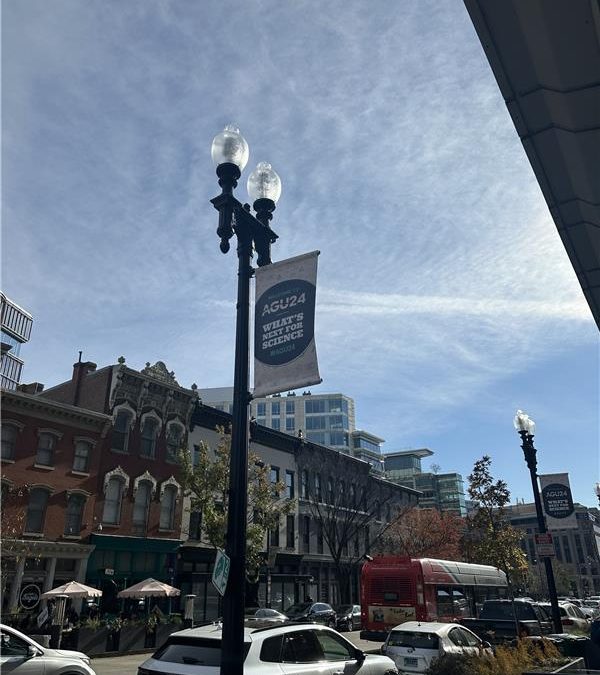
The slogan of AGU 2024 “What’s next for science”.
AGU is a huge conference that involves almost all the fields you can imagine in earth science studies. Though it was not my first time attending this conference, the enormous number of presentations still shocked me. There were more than 27,000 presentations in the conference and hundreds of subsessions. In other words, as a student working on an interdisciplinary program, I was able to find a bunch of studies that match my research a lot or fit one of my disciplines.
This year, the theme of AGU was “What’s Next for Science”. Machine learning is very popular in recent “AI” years, and I saw hundreds of thousands of studies that have applied machine learning models in earth science studies, helping people with observing, mapping, simulating and decision making. The varied applications of machine learning gave me a deep impression, which kind of encouraged me to think about using it in my own research.
I gave an eLightning presentation on how spatial patterns of urban green infrastructure impact the cooling service they provide and how equitable is the people’s access to the cooling service in terms of their socioeconomic status, race and education level in Montreal. I really enjoyed the eLightning presentation type, it’s just like a combination of oral and poster presentations. I gave a 3-minute talk followed by an hour of discussion. Actually, I feel like a 3-minute talk is more challenging than a long talk, as you have to introduce the key points of your research and attract people’s interest as well within such a short time. But I believe I did it well and received much positive feedback. There was almost no blank time during the discussion part, and I was very happy to introduce my research to people coming from similar or different fields. Some of the questions or comments also brought inspiration to me.
I am doing my eLightning presentation. The monitor we used to show our e-poster.Communicating with students from the universities in the U.S.
During the conference, I found an interesting study which is similar to mine but conducted in Maryland, U.S. We had a deep discussion on combining the natural science and social science together to help the stakeholders make more efficient, local-based and balanced policies. We exchanged our contact information and we expect further cooperation in the future.
I also explored the GeoAI tools at the ESRI’s platform. The staff introduced the AI tool in ArcGIS Pro and the applications for ecosystem studies, such as tree segmentation, 3D tree canopy modelling, biodiversity mapping, etc. A bunch of companies that work on environmental assessment showed their products at the conference, and I was impressed by the variety of sensors that can implement air temperature, air quality, or surface temperature monitoring with a high spatial/temporal resolution. As part of my PhD study also involves field measurement, I had some valuable discussions with them and just wondered if there is any possibility to use them in my future work.
The exhibition hall of universities, research institutions and companies.
Most of the research at the AGU conference was conducted at quite a large scale (global or country scale), which gave me a better view of the recent global environmental change. Though my study focused on a relatively small spatial scale (limited to Montreal), the global scale studies still provided great references and inspiration to me. Better communication across various cities could also bring valuable insights for the stakeholders in each individual city.
I was really immersed in the conference, spending the whole time at the convention centre every single day until the end. I feel like I did a “literature review” of the latest earth science progress during these intense 5 days. Thanks to QCBS’s help, I got a great experience in Washington and had a better view of urban heat, air quality, machine learning, community science and decision making studies, hopefully to support the ongoing or future studies in Quebec.
About the author: Lingshan is a PhD student in the program Geography, Urban and Environmental Studies at Concordia University. She is supervised by Dr. Ursula Kross, Dr. Carly Ziter, and Dr. Angela Kross. She is studying the effects of vegetation and the built environment on urban microclimate in Montreal, using a combination of remote sensing and field-based approaches. Her research falls within the Next Generation Cities Institute as well as the DesignLIFES NSERC CREATE.