Par Alice Tanguay, étudiante à la maîtrise à l’Université du Québec à Rimouski
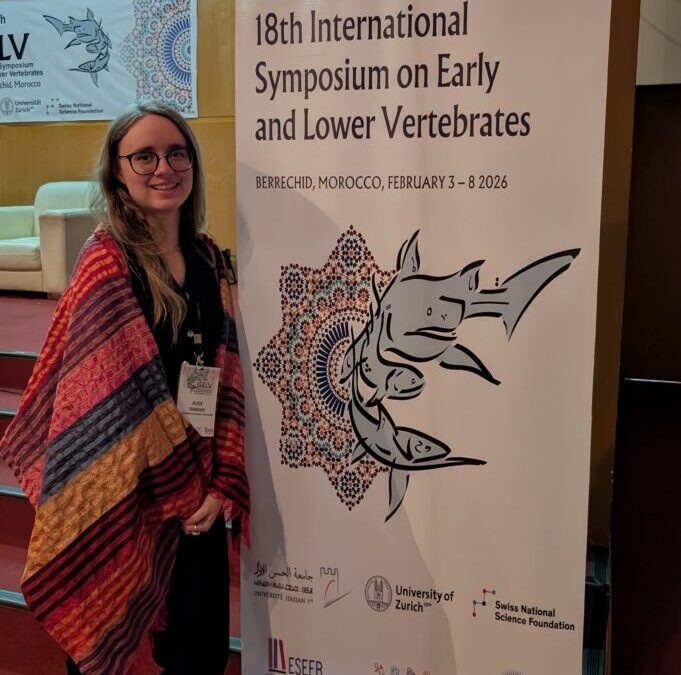
Lors de la première semaine de février 2026, j’ai eu la chance de participer à la 18e édition de l’International Symposium on Early and Lower Vertebrates (ISELV) grâce à la bourse d’excellence du CSBQ. Cette année, la conférence se déroulait pendant une semaine dans la petite ville de Berrechid, au Maroc.
À cette occasion, j’ai présenté une communication de 15 minutes portant sur les résultats de ma maîtrise. Mon projet de recherche s’intéresse à des espèces de poissons fossiles ayant vécu il y a environ 375 millions d’années, au Dévonien. Ces fossiles proviennent du parc national de Miguasha, au Québec, un site classé au patrimoine mondial de l’UNESCO reconnu pour la richesse exceptionnelle de ses fossiles.
Je travaille plus particulièrement sur un groupe fascinant de poissons à nageoires charnues : les porolépiformes. Aujourd’hui disparus, leurs fossiles sont les seuls témoins de leur existence et les scientifiques commencent à peine à dévoiler leurs secrets. Les porolépiformes sont essentiels pour comprendre l’évolution des vertébrés. Cependant, la rareté des spécimens complique l’étude de leur diversité et des relations entre les différentes espèces. Le parc national de Miguasha a permis la découverte de deux espèces de porolépiformes, Quebecius quebecensis et Holoptychius jarviki. Plus récemment, une potentielle troisième espèce a été mise en évidence, bien qu’elle n’ait pas encore été nommée ni décrite en détail.
Spécimen adulte de Quebecius quebecensis
Des rencontres inoubliables
La première journée de la conférence consistait en une soirée de réseautage permettant de briser la glace et de rencontrer d’autres participants. Les présentations se sont ensuite déroulées sur quatre jours. Il s’agissait de longues journées, généralement de 9 h à 17 h. Les conférences avaient lieu dans un amphithéâtre.
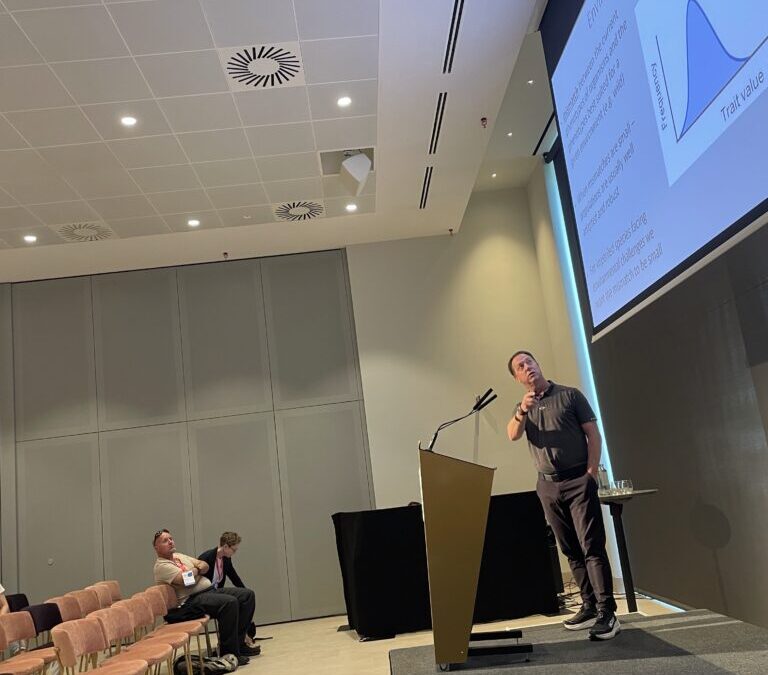
Comme il n’y avait qu’une seule séance de présentation, j’ai eu l’occasion de présenter lors de la dernière journée devant une centaine de scientifiques. Ma présentation durait environ 12 minutes et était suivie d’une période de questions de 3 minutes. L’expérience était particulièrement impressionnante puisqu’il fallait présenter au microphone sous de puissants projecteurs. Toutefois, cela s’est très bien passé et j’ai reçu plusieurs commentaires positifs. Il est toujours intéressant d’obtenir l’avis d’autres scientifiques.
Par la suite, le comité organisateur de la conférence nous a tous amenés à Marrakech, où nous avons eu la chance de visiter la ville et plusieurs sites inscrits au patrimoine mondial de l’UNESCO. Nous y sommes restés deux jours dans un complexe tout inclus, et c’est à cet endroit que la conférence s’est conclue.
Lors de la conférence, j’ai eu la chance de faire des rencontres extraordinaires. En tant qu’étudiante, j’ai pu rencontrer les auteurs des articles scientifiques que je lis et cite depuis le début de ma formation. Ces noms, que je voyais jusque-là uniquement sur des pages de publications, prenaient soudainement vie devant moi, autour d’un café ou lors d’une discussion après une présentation.
Cette expérience m’a permis de les découvrir sous un autre jour, beaucoup plus humains et accessibles que l’image sérieuse que l’on peut se faire en lisant leurs travaux. Derrière les figures importantes du domaine se trouvent des personnes passionnées, curieuses et profondément chaleureuses.
J’ai également tissé des liens précieux avec d’autres étudiants venant des quatre coins du monde, notamment d’Australie, du Japon et du Brésil. Dans cette petite communauté de paléontologie, j’ai ressenti un soutien immense et authentique. Il n’y avait ni compétition ni rivalité, seulement de la bienveillance et ce sentiment merveilleux d’être unis par une même passion.
On a très bien mangé !
Il fallait absolument que je vous parle de la nourriture marocaine ! Nous avons très bien mangé pendant tout notre séjour. Leur cuisine traditionnelle est incroyable : j’ai mangé le meilleur couscous de ma vie. Si vous allez un jour au Maroc, je vous conseille d’essayer les tajines et leurs pâtisseries, notamment la chebakia.
Pour les personnes véganes, cela peut être un peu plus compliqué, mais la cuisine marocaine inclut beaucoup de légumes, donc si vous êtes végétarien, c’est tout à fait faisable. Voilà, je vous mets une petite photo pour vous faire saliver !
Nous n’avons pas vraiment eu l’occasion de visiter Berrechid, puisqu’il ne s’agissait pas d’une ville particulièrement touristique, mais nous avons pu nous reprendre lors de notre séjour à Marrakech. Nous y avons découvert des endroits époustouflants. Les bâtiments étaient ornés de magnifiques mosaïques aux couleurs vives. Nous avons également visité les souks, de grands marchés où les artisans vendent notamment des produits de maroquinerie. Voici une photo de la mosquée Koutoubia, située à Marrakech.
Retour au Québec
Cette conférence m’a donné un regain de motivation pour poursuivre mes recherches et explorer de nouvelles questions scientifiques. Rencontrer des scientifiques venus des quatre coins du monde m’a également permis de développer des partenariats et d’envisager de futurs projets collaboratifs.
À notre niveau, il est facile pour les étudiants de s’isoler et d’oublier la raison pour laquelle nous avons choisi ce chemin. Mais lors d’une conférence, on réalise que notre petit grain de couscous, cette modeste contribution que représente notre recherche, prend tout son sens lorsqu’il se mêle à ceux de chercheurs venus du monde entier. Ensemble, ces grains forment un vaste champ de connaissances, et c’est en voyant cette mosaïque que l’on comprend vraiment l’importance de notre travail.
Cette semaine à ISELV 2026 restera gravée dans ma mémoire. Entre les présentations, les discussions passionnantes et les rencontres humaines, j’ai pu mesurer à quel point la science est une aventure collective. Je repars du Maroc avec de nouvelles idées, des amitiés précieuses et une motivation renouvelée pour mes recherches… et je sais déjà que j’y retournerai avec grand plaisir !
À propos de l’auteure:
Alice Tanguay est étudiante à la maîtrise en biologie à l’Université du Québec à Rimouski, au sein du laboratoire de paléontologie et de biologie évolutive du Dr Richard Cloutier. Elle se spécialise en paléontologie, plus précisément dans l’étude de poissons fossiles datant d’environ 375 millions d’années.
By Morgane Henry, PhD candidate at McGill University
In spring 2022, as I was just finishing my first-year as a PhD student, my supervisor came into the office with an offer I couldn’t refuse: “Would you like to go to a workshop in Marrakech?” Needless to say, I immediately agreed, and that is how I embarked on a series of workshops and side-projects parallel to my main thesis topic that would lead to some really cool research and collaboration.
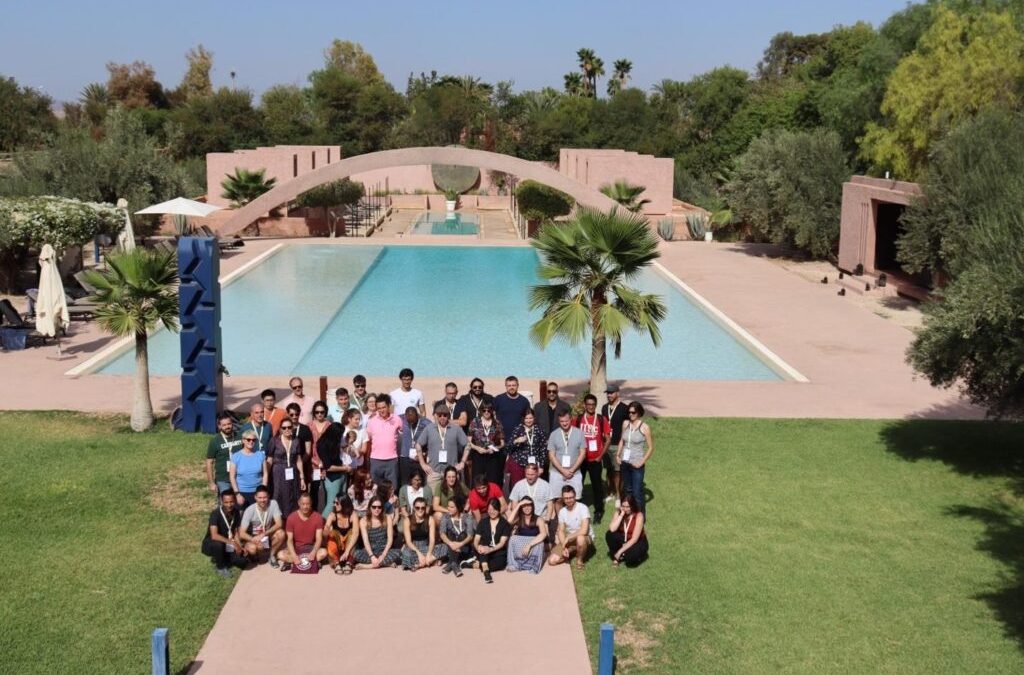
The aim of that first workshop, “InvaCost II”, was to study the global economic impacts of biological invasions using a newly developed, first-of-its-kind database that compiled all known costs caused by invasive species (for example, costs due to crop yield loss or the financial burden to manage these species). That workshop in Marrakech was amazing. It was my first international workshop, and having the opportunity to spend a week in a beautiful place working with brilliant scientists from all over the world was exciting and humbling to say the least.
Participants of the InvaCost II workshop in Marrakech, Morocco
As always when you put 40-ish researchers together, the number of ideas and potential projects grew dramatically every day of the workshop. After a few days, I started focusing on a project aimed at estimating the unknown economic costs of invasive species in the European Union. Of the ~13,000 known invasive species in Europe, only 1% have reported costs, leading to a massive underestimation of the true costs of these alien species in the EU and highlighting the need to develop revised estimates.
Once the workshop was over and I was back in Montreal, we started working on the modelling approach for the Europe project. I will not lie, this was not an easy period for me. The workshop was very stimulating, allowing us to focus only on a single topic without outside distractions. But being back in my routine and having to juggle the regular tasks of grad school, my thesis, and a new, challenging side project was difficult. This period, the winter semester of 2023, was a bit of a blur: in the beginning, I thought I could manage everything, but as the weeks went by, I started to feel more and more pressure and began to feel overwhelmed. I kept telling myself, just one more week and I’ll take a little break, but of course, that week became weeks and I didn’t slow down. I finally hit a breaking point and had to take time away from work to recover. Now looking back and reflecting on this time, I realize how exhausted and burnt out I was; it served as a wake-up call, and I promised myself I wouldn’t get in that same situation again. Rest, it turns out, is also part of the process. After I came back to work, we managed to finish and publish the Europe project. My supervisor and I developed a model capable of extrapolating costs using macroeconomic scaling and temporal modelling approaches. The results of the study were staggering, and we found that costs due to invasive species in Europe could be up to US$28 billion, which is 501% higher than what is currently reported.
After finalizing this side project, I said I wouldn’t do any more side quests and would focus on my thesis, which I did… for about a year and a half. During this time, I prioritized my mental health and my thesis work. I became more confident as a researcher and worked on better listening to how I felt (and not just pushing through). Since I wasn’t really involved with the InvaCost group during this time, I thought it would probably be the end of my collaboration with them. However, to my surprise, I received an invitation in the summer of 2024 to attend the next workshop in the series “InvaPact”: the group would now be focusing on the ecological impacts of biological invasions. At this stage of my PhD, I felt more confident about balancing side-projects and my everyday work, so I accepted the invitation and spent two weeks in Paris a few months later.
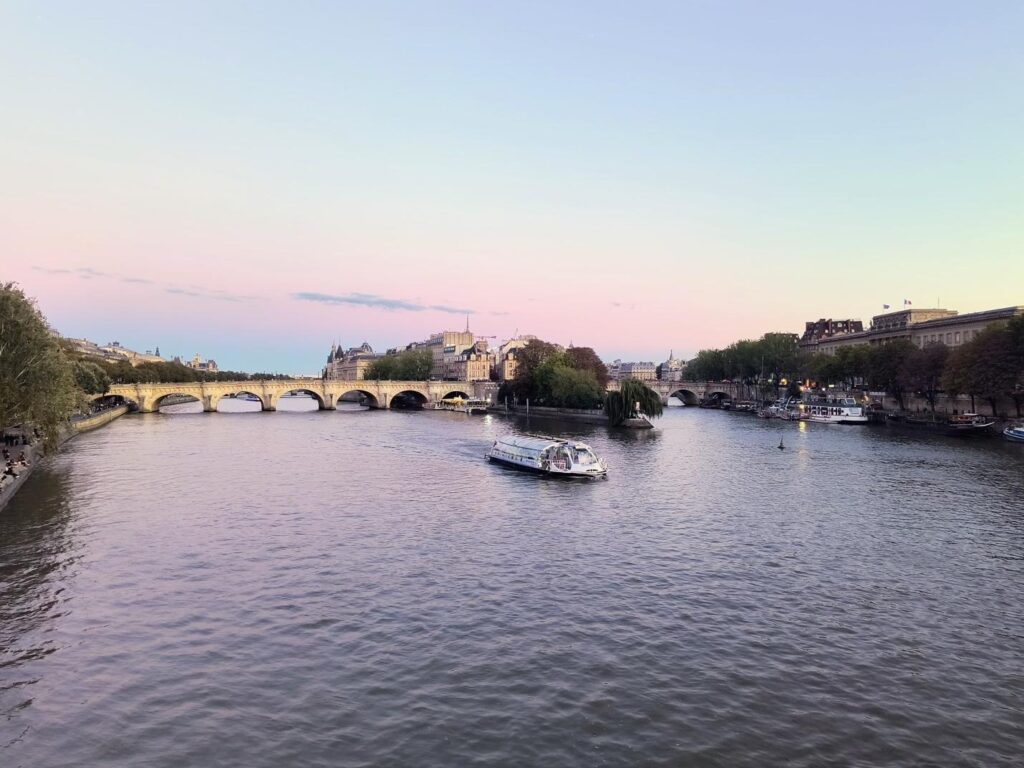
A walk along the Seine at dusk
Attending the InvaPact II workshop was again an amazing experience: I got to see and work with people whom I had met at the workshop two years before, and I met new people in the invasion biology field. This time around, I felt more confident in my skills and in my ability to participate in the discussions. Similar to Marrakech, the number of projects quickly grew, and this time I was careful not to overcommit and only work on a few projects I was interested in and that I knew I could manage. After my time in Paris, I kept collaborating on the InvaPact project. The group met last November again in Barcelona, where several projects took shape — including one I am now leading on the ecological impacts of invasive species in Canada. Stay tuned for the results coming out soon!
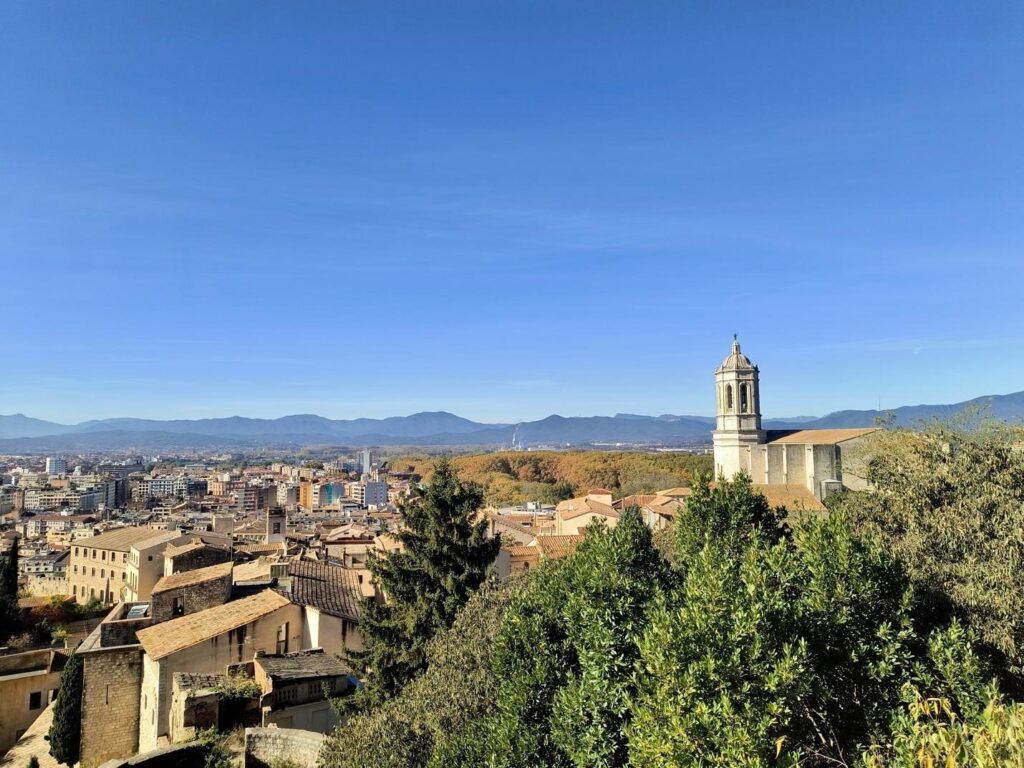
A visit to the old city of Girona in Spain.
Looking back, these workshops and side-projects taught me things I couldn’t have learned from my thesis alone — how to collaborate across time zones and disciplines, how to pitch ideas to people you’ve just met, and how to keep momentum on a project when life gets in the way. The relationships I built through these experiences, and the skills I developed along the way, are ones I expect to carry well beyond my PhD.
For any grad student thinking about taking on side-projects: it can be an incredible experience, but ask yourself whether it aligns with where you want to go, and be honest about your bandwidth before you commit. The best opportunities will stretch your limits, but know where the line is before you cross it.
About the author
Morgane is a PhD candidate in the Leung Lab at McGill, where she studies the spatial and temporal dynamics of insect outbreaks. In particular, she focuses on the spruce budworm, a moth species native to Quebec that causes cyclical outbreaks, leading to millions of hectares of defoliation and widespread mortality among conifers. Website: https://morgane-henry.github.io/
By Veronica Groves, PhD candidate at McGill University
Between July 8th-11th 2025 I participated in the Society for Experimental Biology (SEB) 2025 annual conference in Antwerp, Belgium thanks to support from the QCBS Excellence Award. For the first time in my career, I attended a conference not only as a presenter, but also as a session organizer. Alongside Dr. Britney Firth (University of Waterloo) and Dr. Sean Tomlinson (Government of Western Australia), I helped organize a session on “Shared challenges and diverse approaches to physiology in conservation across taxonomic boundaries”, in which I also presented a research talk on “The challenges related to using the minnow Blackchin Shiner (Miniellus heterodon) as a surrogate for the Threatened Pugnose Shiner (Miniellus anogenus)”.
First, why try to organize a session as a graduate student? For one, I found that organizing a session as a PhD student allowed me to increase my academic profile by putting myself on more people’s radars. When you organize a session, your name appears in the booklet, and you are on stage introducing speakers, both of which may mean that more eyes are on you. Secondly, it allowed me to get greater insight into what organizers look for in submitted abstracts, which can inform how I submit my work for future conferences. Thirdly -and this is conference specific – but there can be additional funding available to session organizers that can help offset the cost of attending the meeting.
But how do you go about organizing a session? This can really depend on the type of conference. SEB strongly encourages early career researchers (ECR) to participate in organizing sessions – and they advertise it as such. Other conferences may not explicitly say that ECRs are welcome to submit a session, but you do not know until you ask (as I say, “shooters shoot”). If you do end up deciding to organize a session, I found that it was very helpful to collaborate with more experienced colleagues. Dr. Firth was someone that I actually met at my very first conference in 2022 and we remained in contact (which speaks to the power of networking and building relationships!), and they reached out to me, as a more junior ECR to ask if I wanted to collaborate on the session as we both study the eco-physiology of species at risk in Canada. Then, we wrote an abstract detailing what we were looking for in a session and submitted it to SEB. For reference, our abstract was:
“Surrogate species, defined as a species that effectively represents another species that is usually the target of research, are suggested as a tool in applied conservation ecology to overcome limited data availability to inform decisions (Caro et al., 2005; Cooke et al., 2017; Castaneda et al., 2021). Surrogates can be a closely related species, or a member of the same target species but from a different geographical area (Castaneda et al., 2021). They can be selected based on similar traits such as habitat use, physiology, or phylogeny, and ideally they would respond to a stressor in the same way as the target species. However, there are major challenges to using surrogate species, namely identifying a suitable candidate and interpreting the results. Comparative physiology is a technique that we can use to bridge the gap between target and surrogate species by understanding how and why some species are winners vs losers when faced with anthropogenic stress.”
Once a session is accepted, what is next? Well, for SEB we were tasked with reaching out to prospective speakers, reviewing and accepting the abstract submissions and building a schedule for the session. These were tasks that had to be completed ahead of time. Then, on the day of the session, we had to briefly introduce each speaker, keep time so that they did not go over their allotted slot, and ask questions if there were no audience questions. An important tip here is to ask the speakers in advance how to pronounce their name (there is nothing worse than when you are introduced wrong) and I recommend writing out the phonetic spelling so that you can introduce everyone properly.
Hopefully this blog can empower other ECR to branch out and take on greater roles in their academic and scientific societies as session chairs!
About the author:
Veronica Groves is a PhD candidate in the Biology Department at McGill University under the supervision of Prof. Lauren Chapman. Having completed a H.BSc. Agri. Envr at McGill University and MSc. at Concordia University, Veronica specializes in the impacts of multiple stressors on freshwater fish behaviour, physiology, and life-history through the lens of conservation.
Par Gabrielle Bibeau Lapierre, étudiante à la maîtrise à l’Université de Sherbrooke
Écologiste de formation, j’ai d’abord eu du mal à accepter une maîtrise axée sur la modélisation, avec peu de perspectives de terrain. C’est dans ce contexte que j’ai saisi l’opportunité offerte par les prix Champions Blitz the Gap. Ma maîtrise porte sur la modélisation de la distribution des champignons du Québec à partir des données d’iNaturalist. Pour enrichir ces données, je me suis équipée de guides d’identification, d’un véhicule, et surtout d’amis biologistes, pour explorer la réserve faunique de La Vérendrye au Québec — un territoire généralement peu documenté, notamment en matière de champignons, comparativement au sud du Québec.
——
Jour 1 :
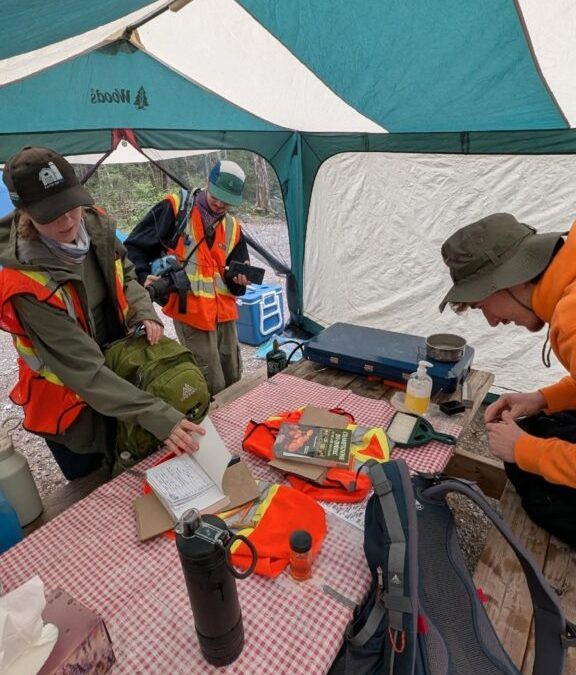
Préparation du matériel d’échantillonnage pour la journée sous l’abri-cuisine. Crédit photo : Aryan Morin-Comptois
Après une installation sous la pluie la veille, nous avons enfin pu commencer le terrain. Pas besoin d’aller bien loin pour observer une belle diversité : un simple tour du camping de la Baie des Sables, notre ‘domicile’ temporaire, nous a permis d’identifier près de 50 spécimens différents. Un recensement précieux, considérant qu’une seule observation fongique (un lichen) avait été enregistrée à cet endroit avant notre venue.
Jour 2 :
Arrêt en kayak sur une île du grand lac Victoria. Crédit photo : Aryan Morin-Comptois.
Pour bien s’éloigner des routes et atteindre les coins les plus reculés, nous avons loué des kayaks pour la deuxième journée d’échantillonnage. Malgré le courant capricieux et nos bras endoloris par les coups de pagaie, nous avons effectué trois arrêts riches en découvertes fongiques. Que demander de plus lors de notre seule journée ensoleillée de la campagne d’échantillonnage?
La troisième journée, nous avons circulé sur la route 29, nous arrêtant à plusieurs reprises pour échantillonner. C’est là que nous avons trouvé notre seul hydne de la semaine : Hydnellum caeruleum. Un hydne est un champignon dont les structures porteuses de spores prennent la forme d’aiguillons — de petits filaments.
Jour 4 :
Écologiste in the wild! Un bel étang de castor dans la ZEC Bras-Coupé-Désert. Crédit photo : Gabrielle Bibeau Lapierre
Pour notre dernière journée, nous avons fait un arrêt sur la route à la ZEC Bras-Coupé-Désert afin de prélever quelques échantillons en milieu humide. Quoi de mieux pour conclure le périple qu’une belle vue sur un étang et un thalle de lactaire à odeur d’érable (Lactarius helvus)?
——
En somme, ce fut un court voyage à la réserve faunique de La Vérendrye, mais rempli de champignons : une quarantaine d’échantillons physiques seront ajoutés au Fungarium de l’Université de Sherbrooke, et plus du double en observations iNaturalist.
À propos de l’auteure:
Gabrielle Bibeau Lapierre est étudiante à la maîtrise en Biologie à l’Université de Sherbrooke. Elle se spécialise en mycologie, en écologie et en modélisation. Curieuse et engagée, elle participe activement à des initiatives de vulgarisation scientifique, avec le désir de rendre la biologie accessible et captivante pour tous les publics.
By Laura Lardinois, PhD Candidate at McGill University
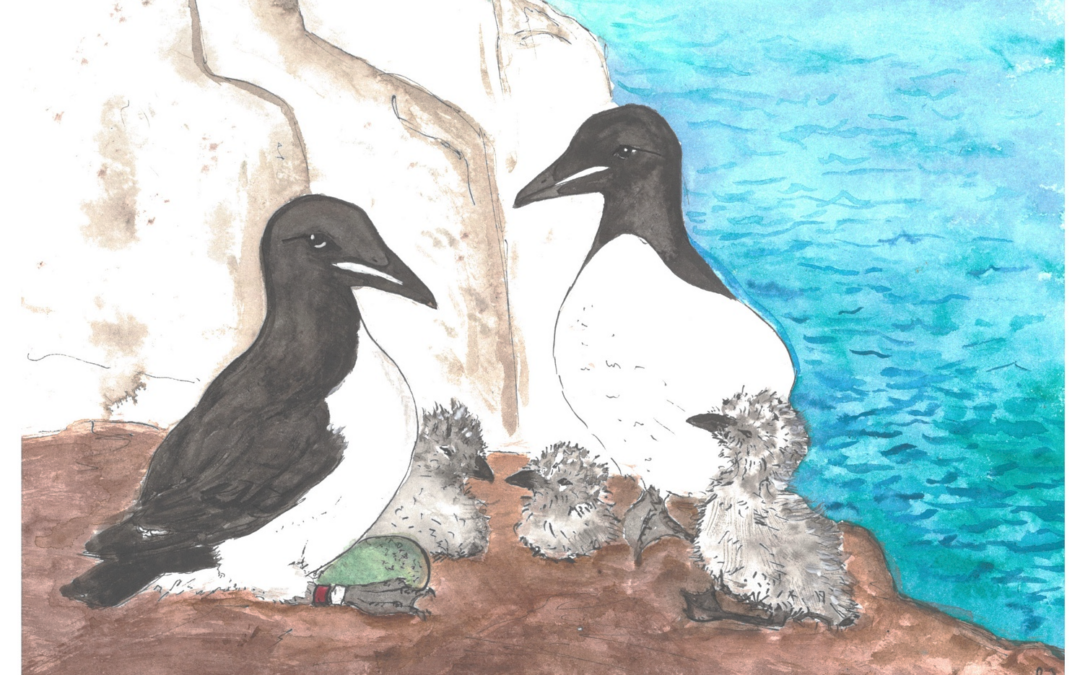
In the coldest months of the year, I had the chance to step briefly away from my thesis and immerse myself in records of summers spent in Akpatuurjuaq,ᐊᑲᐸᑑᕋᔦᕋᑲ (Coats Island, Nunavut), much further north than I’ve ever been. This small island on the northern edge of the Hudson Bay has breeding colonies of thick-billed murres (Uria lomvia, akpa, ᐊᑲᐸ), which, thanks to decades of annual surveys, are the most well-studied in the world. These Arctic seabirds, which are in the same family as penguins and puffins, are culturally significant for Indigenous communities and serve as indicators of environmental change.
Since the 1980s, teams of researchers from Environment and Climate Change Canada and McGill University have been going out to this remote island each summer to band birds, count population sizes, measure chick growth, observe feeding behaviour, and track reproductive success. This has generated huge quantities of valuable data, collected first on paper in the field, then entered into physical tables pre-Excel, then digitized in various spreadsheets and file types across the years. My job, as a data rescue intern with the Living Data Project, was to pick up where a previous intern left off a few years ago and wrangle these data into a clean, well-documented dataset that could be archived and made publicly available.
Field notebooks from the past few years (left) and paper logs (right) from the first 3 decades of monitoring (luckily, the data was already digitized for me)
At first, I was overwhelmed by the sheer number of files, not to mention the unfamiliar abbreviations, many tabs, and different information types. In some cases, having banded birds in a natural history course (thanks, Professor Trombulak!) came in handy when deciphering the data, but other information was more cryptic, especially without having been in the field to observe these murre colonies first-hand. Much like a novel starting in medias res, I was scrambling to get to know the cast of characters in these datasets, including not only the focal birds, but also the hundreds of observers who logged notes in field notebooks across four decades. Luckily, everyone who had been involved over the years was willing to help patch together their memories, including a memorable email sent from high elevations in the Himalayas to clarify chick hatching dates in the 1980s. I was also fortunate to visit the teams actively working on the project in person, spending a day at ECCC in Ottawa and another flipping through field notebooks and the original paper logs from 1981 through the early 2000s at McGill’s Mac Campus.
Little by little, I began to latch onto patterns in the data and link them to conversations with the researchers who have led these monitoring efforts. For instance, some datasets had negative date values, which were the product of early years being recorded as “date since June 1st”, since most of the breeding monitoring would start in June. However, in some years, crews came out early, resulting in -2 date values that needed to be converted back to May 29th. Through the field notes, I caught glimpses of the reality of field work on Coats Island: sighting polar bears could end a day of monitoring, and several monitoring plots were relocated due to too much bear activity. Bird counts or other observations could be cut short by bad weather and poor visibility.
Thick-billed murres, I learned as I tracked down hand-drawn maps of the study plots, nest on the very edge of rocky cliffs, effectively dotting the entire cliff face with black and white as they compete for prized nesting spots. Their eggs have a fun conical shape, which keeps them from rolling off the cliff. As I dug deeper into the data – and sent a slew of clarification emails to the amazing Coats Island research team – labels like “Q 37” changed from abstract alphanumeric codes to a specific nesting pair tucked into a crowded ledge.
Similarly, I learned to recognize the patterns of band IDs used to identify each bird: when caught, murres are banded with metal bands that have unique number codes to identify them when resighted or recaptured. In early years, bands had 8-digit codes starting with ‘996’, while recent years have switched to 9-digit codes. When they’re first banded, the complete band number is recorded, but sometimes, if you see the bird again through the binoculars, only parts of the band are visible, so I had to find ways to account for incomplete values. These band IDs are key, since they let us track an individual bird across time and link morphological data, its breeding site(s), potential partner(s), reproductive success, and any other data collected.
With so many moving pieces, making lists of files, the date ranges they cover, what information they contain, and how they’re linked to other files, was critical to preserving my sanity. I also learned the value of making a changelog early on, to keep track of any issues I came across or modifications I made in a systematic manner. Usually, catching and trying to fix one issue in the dataset would dig up several others in the process, so being able to flag these to return to later was extremely helpful. Furthermore, tracking these changes systematically – alongside well-annotated code of what I’ve done – will allow others to pick up where I leave off and hopefully continue archiving new versions of this dataset after this summer’s field season.
About the author:
Laura Lardinois is a PhD Candidate in the Barrett Lab at McGill University, co-supervised by Matthieu Leray at the Smithsonian Tropical Research Institute. Her research revolves around marine microbiomes and how they – in tandem with their animal hosts – can survive and adapt to both natural and anthropogenic environmental change. She was recently a data rescue intern with the Living Data Project, helping archive 40 years of Arctic seabird monitoring data. She integrates multilingual science communication, outreach, and art into her research to share it with broad audiences. Laura is an editor at Le Beagle and a local representative for the QCBS.
Par Audrey-Anne Laurin, étudiante au doctorat à l’Université du Québec en Outaouais (UQO)
C’est en direction de Melbourne, en Australie, que je me suis dirigée à l’automne 2024 pour participer au congrès de la International Society for Behavioral Ecology (ISBE). D’ailleurs, il était initialement prévu que la communauté internationale se retrouve en Australie pour ce congrès bisannuel en 2022, mais avec les frontières qui restaient encore fermées aux touristes en raison de la pandémie, cette destination avait été repoussée à cette année. Ainsi, avec près de 4 années de préparation sous leur manche, nous avons été témoins d’un des congrès les plus réussis qu’il m’a été possible d’assister. En effet, le comité d’organisation s’est surpassé afin d’offrir un congrès à la fine pointe de la technologie (nous avions même une application mobile !), écoresponsable et inclusif.
J’y présentais les résultats d’un de mes chapitres de doctorat, qui porte sur la prédiction de la répartition de la tique à pattes noires (Ixodes scapularis) à partir de la dynamique spatiale du cerf de Virginie (Odocoileus virginianus). Le cerf de Virginie est l’hôte principal de la tique à pattes noires, c’est-à-dire qu’il permet à la tique adulte de prendre son dernier repas de sang et de se reproduire (parfois même sur le cerf lui-même !). Par la suite, la tique va tomber au sol afin de pondre ses œufs, créant ainsi la prochaine cohorte à cet endroit. Je cherche donc à savoir si l’utilisation d’habitat du cerf, et tous les facteurs qui influencent cette utilisation (e.g. disponibilité en nourriture ou en abris, risque de prédation), permettent de prédire où les tiques se retrouvent. J’utilise pour cela un réseau de caméras de chasse, couplé à des prélèvements de tiques sur le terrain. Mes résultats suggèrent que plus un endroit est utilisé par le cerf, plus la probabilité d’y trouver des tiques est élevée. Et surprise, d’autres animaux semblent être des transporteurs d’intérêt, notamment le raton laveur, qui a d’ailleurs la malheureuse habitude de se tenir à proximité des zones fortement utilisées par l’humain (e.g. aires de pique-nique ou de camping) ! Dans les secteurs où les populations de tiques à pattes noires sont en émergence comme c’est le cas dans plusieurs régions au Québec, un suivi des hôtes clés de la tique permettrait de prédire les endroits plus à risque pour l’humain et d’y cibler les efforts de prévention. Avec les nombreux pathogènes que la tique a le potentiel de transmettre, ces connaissances sont essentielles dans notre combat contre ces minuscules créatures ! L’utilisation d’un outil comme les caméras devient une approche innovante et accessible aux divers intervenants.
Image recueillie à l’aide du réseau de caméras, Parc de la Gatineau (Québec)
Ayant auparavant eu la chance de discuter d’un autre chapitre de mon projet de recherche à ce plus important congrès en écologie comportementale à l’échelle mondiale, c’était une chance exceptionnelle de voir cette opportunité se présenter à nouveau ! En plus de représenter un défi important au niveau de la langue, cette fois-ci mélangée à un bel accent australien, le tout m’a permis d’échanger avec des têtes renommées du domaine, de découvrir de multiples sujets de recherche inspirants et d’explorer des projets pertinents.
J’ai pu également découvrir une ville vivante, où la faune et la flore nous rappellent que nous sommes effectivement à l’autre bout de la planète ! Que ce soit en allant marcher au bord de la baie, en allant visiter le jardin botanique royal ou encore en visitant les forêts d’eucalyptus du Grampians National Park, tout était un rappel du caractère unique de ce pays. Et ces nombreuses découvertes, je les dois entre autres au Prix d’Excellence du CSBQ, bourse généreuse qui m’a permis d’alléger les coûts d’une telle expérience enrichissante.
Jardins botaniques royaux de Melbourne, Australie
Grampians National Park, Australie
Si vous vous posez la question à savoir si les 24 heures de voyagement aller puis retour, en plus des 14 heures de décalage horaire en valent la peine, je vous répondrai que oui, mais je vous recommande d’y rester plus d’une semaine !
À propos de l’auteure:
Je suis actuellement étudiante au doctorat à l’Université du Québec en Outaouais (UQO), dans le laboratoire d’Angélique Dupuch à l’Institut des Sciences de la forêt tempérée (ISFORT). Je m’intéresse aux interactions interspécifiques, utilisant le concept théorique de la cascade trophique comportementale pour démystifier la dynamique spatiale du Cerf de Virginie. Plus particulièrement, j’étudie le système Grands canidés – Cerf de Virginie et son impact sur la régénération forestière ainsi que sur la répartition de la tique à pattes noires, responsable de la maladie de Lyme.